

Is your dog acting drunk? Vestibular disorder might be the reason

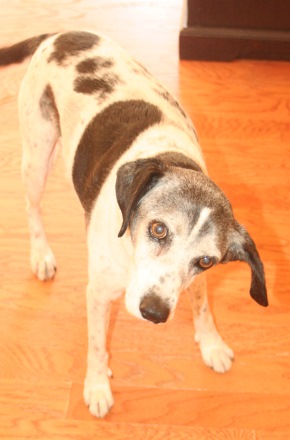
Leaning the head to one side is a classic symptom of canine vestibular disorder. / Photo: Katerina Lorenzatos Makris
by Katerina Lorenzatos Makris ~
Only a few days home in California after a long absence overseas, I awoke one morning to hear my husband’s anxious announcement: “Dio is staggering. He can’t really stand. He doesn’t want to eat. And he just threw up.”
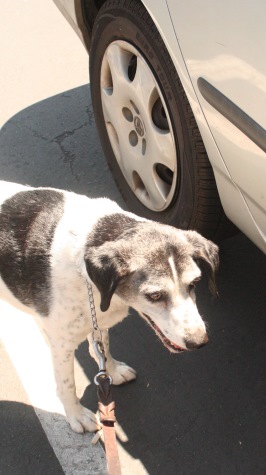
Arriving at the vet’s office, Dio held his head a little straighter. “Look, I’m fine now. No need to go in there. Really.” / Photo: Katerina Lorenzatos Makris
I took a look and found that our eldest pooch, Dio (Diogenes), who we rescued from the streets on the Greek island of Zakynthos back in 2001, was suffering not only from the symptoms my husband noted, but an additional one—an important clue that in my mind pointed to a particular ailment in older dogs: Dio held his handsome black-and-white head cocked so far to the side, almost perpendicular to the floor, that he kept falling over with the weight of it.
And then, as if things weren’t bad enough, I spotted yet one more symptom. Horrified, I watched as his left eyelid performed rhythmic twitching, with both of his eyeballs making small but pronounced jerky movements from side to side.
He was miserable. And so were my husband and I, feeling sick at the sight of our normally energetic and fun-loving senior citizen in such condition.
Though I was pretty sure I could guess the cause of these disturbing symptoms—they seemed to be a classic set that coauthor Shelley Frost and I had written about in the health care chapters of our book Your Adopted Dog: Everything You Need to Know About Rescuing and Caring for a Best Friend in Need (Lyons Press, 2007)—I called the vet and rushed Dio straight in.
‘The room is spinning around him’
“Poor guy,” Dr. Alice D’Amore cooed to Dio as she walked into the examining room. “This isn’t much fun for you, is it?”
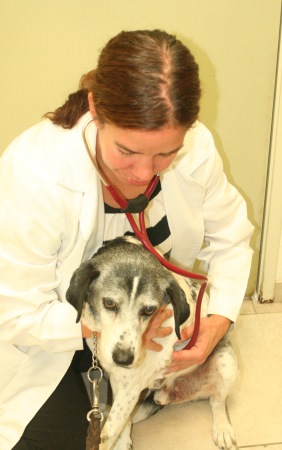
Dio gets exam plus love from the aptly named Dr. D’Amore. / Photo: Katerina Lorenzatos Makris
She got down on the floor with him, because she didn’t want to make him feel even more dizzy by putting him on the exam table, and performed the standard checkup—gently peering into his eyes, ears, and mouth, and listening to his heart.
Then she turned to me. “Vestibular disorder.”
I nodded in relief. That ailment is indeed no fun, but it’s not the end of the world like some diagnoses might be.
“It’s where a nerve in the ear gets irritated for some reason,” the vet explained, “causing dizziness and loss of balance. It would be the equivalent of vertigo in humans.” She stroked our boy’s back and cooed to him some more. “It’s pretty unpleasant for them. For Dio right now, it’s like the room is spinning around his head.”
Waxy ears
Being the type of doggy mom who will grab at any reason to feel guilty and personally responsible for her babies’ ailments, I was given a nice juicy excuse for it when Dr. D’Amore took Dio to the back room and removed tons of wax and debris from his left ear.
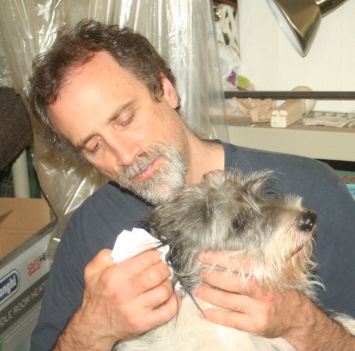
A few days after I finally made it home from Greece, hubsy and I took our pooches one by one into the garage and cleaned their ears, including the floppy flappers on this fellow, Periklis. While I was gone he had managed to do this chore about once a month, which isn’t bad, but some dogs need it more often—about two to four times per month—because their ears produce more gunk. / Photo: Katerina Lorenzatos Makris
That news made my guilt take wing. While I was out of the country for a very long time, it was hard for my husband to keep up with some of the routine maintenance for our many rescued pooches. He did a fabulous job of making sure they were well-fed, properly exercised, frequently bathed and groomed, and copiously loved, but understandably fell a little behind on some of the other tasks like ear cleaning, tooth brushing, and nail clipping. If only I’d been here, instead of off in Greece rescuing other pooches, maybe this wouldn’t have happened to our sweet Dio.
But while I wallowed in guilt, Dr. D’Amore was busily planning the next steps, and seemed somewhat hopeful about the possibility that the cause of the vestibular disorder might just be an inner ear infection. If so, that would have a relatively easy cure.
“I can’t say for certain since I can’t see into the inner ear,” she explained, “but let’s give him an antibiotic in case an infection in there is the problem.”
Also she suggested giving him an subcutaneous (under the skin) injection of fluids while he was there in the office to keep him from getting dehydrated, since he felt too sick to drink water, as well an injection of Cerenia to combat the nausea.
Medication smorgasbord
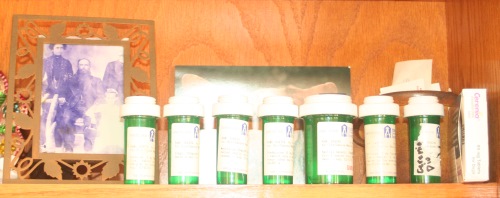
Dio’s pharmacy; for moral support, I kept the pills next to a photo of my Greek grandma when she was little, because her own deep love for animals is one of the reasons I can’t resist them either / Photo: Katerina Lorenzatos Makris
Dr. D’Amore prescribed so many other drugs that my own head started spinning.
“Do we really have to give him all of these?” I queried feebly. “Sometimes I seem to have bad luck when I load a dog up with a bunch of meds all at once.”
“Well, I understand,” the vet replied, “but these pretty much are the standard protocol. And they really should help him get through this.”
I agreed and went home armed with a pharmaceutical smorgasbord.
We had Cerenia in pill form for nausea, antihistamine Meclizine for motion sickness, and antibiotic Baytril. This would be on top of the Soloxine he’s been receiving daily for years for his hypothyroidism.
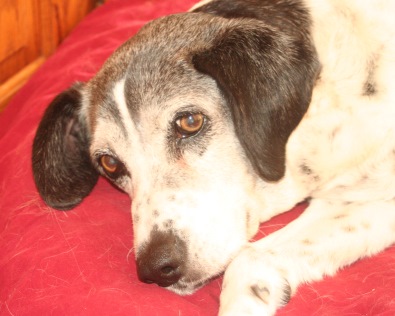
Dizzy and tired, Dio glued himself to his bed after we got home from the vet, but the meds would soon help him feel better / Photo: Katerina Lorenzatos Makris
Dr. D’Amore recommended a bland diet of boiled chicken and white rice, which would be easier to digest than his usual food. I bought for him a few cans of Purina EN Gastroenteric, a purportedly soft-on-the-tummy food sold in the vet’s office.
She gave him a few final backrubs. “Hope you feel better soon, Dio.”
I misted up in gratitude. It’s a nightmare watching our fur babies suffer, and it can make all the difference to have a caring vet.
For more info on vestibular disorder and other problems animals face, please FOLLOW Spicy Stories Save Lives by clicking the ‘SUBSCRIBE’ button above. You’ll receive email notifications of our new articles, we will NEVER give your email address to anyone else, and it’s FREE!
Please note: Spicy Stories Save Lives proudly donates part sponsorship for many needy animals in Greece, where we found Dio (Diogenes), on the streets of the Greek island of Zakynthos back in 2003.
Meanwhile, Kefalonia Animal Trust (KATs) provides free spay/neuter for hundreds of animals per year on a neighboring island, Kefalonia. Please give to KATs via PayPal or bank transfer. Spay/neuter and education are the animals’ best hope for a better future.
Also please consider Animal Rescue Kefalonia (ARK), another group on the island who run a shelter and work miracles with terribly few resources.
Spicy Stories Save Lives and the author of this article have no affiliation with KATs and ARK other than as a friend, volunteer, and donor.
 Seen our book? Your Adopted Dog: Everything You Need to Know About Rescuing and Caring for a Best Friend in Need, by Shelley Frost and Katerina Lorenzatos Makris, available through Amazon.com.

Sep 25, 2014 @ 14:40:38
I would love to be in your group and send me something on dog’s and alligators