
Awesome Animal Facts: Roadrunners eat rattlesnakes, sweat salt through their noses, star in cartoons

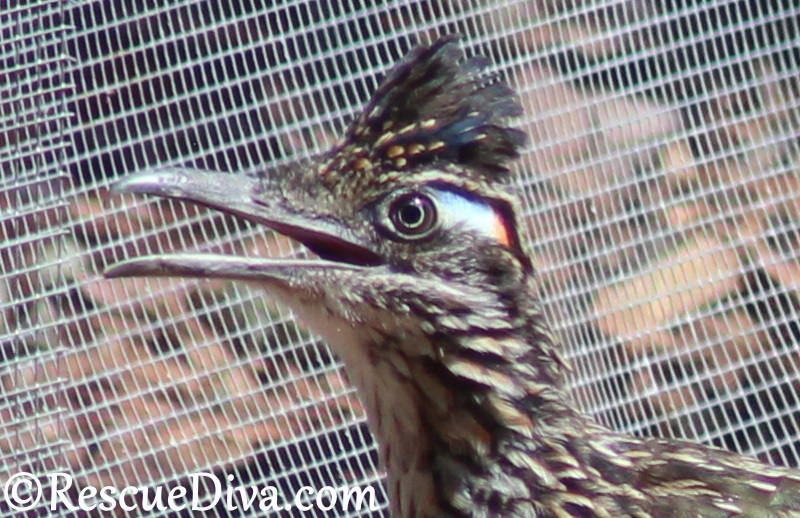
One hot afternoon I heard funny clicks and clucks in our southern California yard. Turned out to be from this awesome animal.
by Katerina Lorenzatos Makris ~
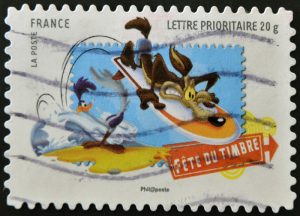
The Road Runner and Wile E. Coyote cartoon characters turned up on a French postage stamp. Who’d a thunk? [Photo: BigStock]
A childhood in 1960s U.S.A. meant that I saw a certain bird on TV nearly every day. The Looney Tunes cartoons starred a character called “Wile E. Coyote” ceaselessly chasing another who was simply named “The Road Runner.” It wasn’t until midlife that I saw one of these birds in person, quite startled to spot one right in my own southern California yard.
What alerted me to his/her presence last week were strange vocalizations like indignant clucks, romantic coos, little puppy whines, and strings of staccato clicks.
Watching discreetly through the window of our Rescue Diva headquarters office as the bird dashed to and fro, I realized I knew nothing about this species other than what I’d learned from the cartoons: they’re kind of goofy-looking, have fluffy feathers on top of their heads, are dazzlingly fast on the ground, don’t fly much, and coyotes want to eat them.
Swallow rattlesnakes whole
Before I reached any listings about the animal itself, Googling the term “roadrunner” turned up three whole pages of hits for businesses such as sports shops, airport shuttles, and trucking companies who use that name.
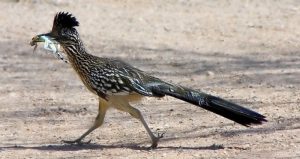
Reptiles, insects, birds, small mammals, and fruit make yummy fare for a road runner. [Photo: BigStock]
The first useful listing was the Desert USA website, which told me that the clicking sound I’d heard is produced by the bird rubbing its jaws together.
Desert USA also provided the following, somewhat shocking paragraphs…
Because of its lightning quickness, the roadrunner is one of the few animals that preys upon rattlesnakes. Using its wings like a matador’s cape, it snaps up a coiled rattlesnake by the tail, cracks it like a whip and repeatedly slams its head against the ground till dead.
It then swallows its prey whole, but is often unable to swallow the entire length at one time. This does not stop the roadrunner from its normal routine. It will continue to meander about with the snake dangling from its mouth, consuming another inch or two as the snake slowly digests.
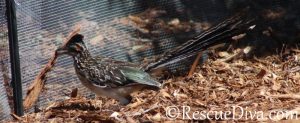
These birds build their nests in trees, shrubs, or even cactus. using sticks lined with all kinds of goodies like grass, feathers, bits of snakeskin, and even dried manure. Cozy!
Info source: Nature Conservancy
Scorpions, tarantulas, and centipedes also make tasty snacks. Flying creatures like dragonflies and even hummingbirds can be snatched out of the air due to road runners’ speedy reflexes. They have been known to hang out near bird feeders to wait for unwitting prey. Not completely carnivorous, though—fruit is another favorite food.
Hot and dry weather preferred
The “Greater roadrunner” species, as it’s officially known (Latin name Geococcyx californianus) belongs to the Cuckoo family, distinguished by having feet with two toes pointing forward and two pointing backward.
About 20 inches long from beak to tail, they can run at least 15 miles an hour, but can’t manage flight for more than a few seconds at a time. Usually they have to feel seriously threatened or be headed downhill to even accomplish that.
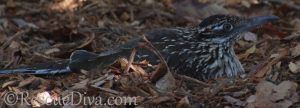
The bird picked a shady, camouflaged spot in our yard to rest.
Adapted to extremely hot and dry climates, this avian can go without drinking water if it gets enough juicy foods. It can conserve moisture by reabsorbing water from its poop before defecating (sorry—gross but true!). Excess salt gets eliminated through a nasal gland instead of through urine like in most other birds.
‘Hey baby, howzabout a blade of grass?’
State bird of New Mexico, the roadrunner is found in a span from Missouri across the U.S. southwestern states from to California, and southward into Mexico, throughout the Mojave, Sonoran, Chihuahuan and southern Great Basin deserts.
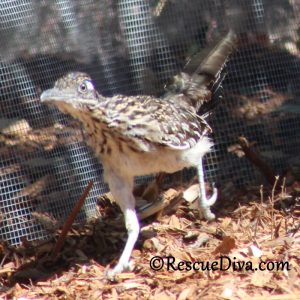
The bird’s quick dashes along a fence made photos hard to snap. But in this pic you can see something of those backward-pointing toes.
Dating rituals are rather quaint, as described by Audubon.org: “One bird (either sex) approaches the other with stick or blade of grass, and drops it on the ground or gives it to other bird.”
Courtship can also include “chases on foot, with frequent pauses to rest. In other displays, male runs away from female with tail and wings raised over back, gradually lowers wings; male wags tail from side to side while slowly bowing.”
Who can resist a guy who bows?
The coyote (and house cat) are after you!
Unfortunately for roadrunners, coyotes appear not just in the cartoons—they’re in real life, eager to enjoy a feathery meal. House cats, too, are wily roadrunner predators, along with hawks, raccoons, certain snakes, and even skunks.
Cold temperatures pose another threat. The birds aren’t built to handle icy weather.
Audubon.org reports that roadrunners might be in long-term decline in California. Let’s hope that trend can be reversed. I would love to hear the funny clicks and clucks and see their goofy, fluffy heads around here more often.
HELP US SAVE ANIMALS — just $2 ! Rescue Diva depends on sales of our romantic fiction to help create real-life happy endings like those of Claire, of Noble, Granger, and Raza, and of Rhea and her Earthquake Puppies.

Buy this fun fiction story–just $2 ! ALL PROFITS go to animal rescue!
Enjoy a fun read, spice up your life, and help replenish our rescue fund! 🙂
Try our fiction story “Small Change,” about a bitter woman who is transformed by a visit to an animal shelter. ALL PROFITS go to CAPE’s Ruff & Ready program and another great group, Last Chance at Life.
Rescue Diva proudly sponsors needy animals in the U.S. and around the world. For example:
~ We help Kefalonia Animal Trust (KATs) in Greece provide free spay/neuter for hundreds of animals per year, which is one of the best ways to prevent the abandonment and misery of puppies like Noah and Kyla.
~ We donate to Center for Animal Protection and Education (CAPE), Praying for Paws, Southern California Siamese Rescue, Aniplant (Cuba) and many other groups.
~ We do in-the-trenches rescues of angels like Robin, Chance, and Tiger, with help from San Diego Animal Support Foundation, and of Marisol and Lisa, with help from Last Chance at Life.
DON’T MISS ANY DIVA! Hit FOLLOW button above.
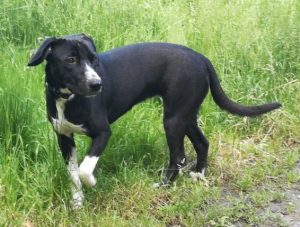
Profits from our fiction stories are used to rescue animals like Dolly, who was tied to a post and beaten. Click pic for more about Dolly. [Photo: Bob DeCosemo]
Katerina Lorenzatos Makris is a career journalist, author, and editor. Her fiction includes 17 novels for Simon and Schuster, E.P. Dutton, Avon, and other major publishers (under the name Kathryn Makris), as well as a teleplay for CBS-TV, and a short story for The Bark magazine. She has written hundreds of articles for regional wire services and for outlets such as National Geographic Traveler, The San Francisco Chronicle, Travelers’ Tales, NBC’s Petside.com, Animal Issues Reporter.com, and Examiner.com (Animal Policy Examiner).
Together with coauthor Shelley Frost, Katerina wrote a step-by-step guide for hands-on, in-the-trenches dog rescue, Your Adopted Dog: Everything You Need to Know About Rescuing and Caring for a Best Friend in Need (The Lyons Press), coming soon in digital format!