
5 animals who are smarter than you thought

HELP US SAVE ANIMALS — BUY A ROMANTIC STORY — JUST $2 !
by Brad Schreiber ~
You may assume that human beings are the smartest creatures due to the average of 86 billion neurons in the brain, governing everything from language to space flight to opening milk cartons glued tightly shut.
But this is no reason to denigrate animals and insects, whose innate cognition and sensitivity are often surprising. In certain instances their intelligence parallels our own.
Who you calling a stupid cow?
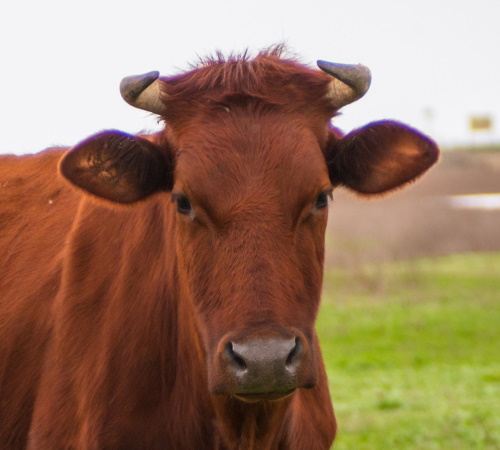
If you have ever referred to someone as a “stupid cow,” despite how imbecilic that person might have been, you need to chew your cud a while and reconsider doing it ever again.
Neuroscientists Lori Marino and Kristin Allen published in the journal Animal Behavior and Cognition their findings on “The Psychology of Cows.” Cattle display “the ability to rapidly learn different tasks, possess long-term memory, extrapolate the location of a hidden moving object and discriminate humans from one another.”
DNA analysis has ascertained that cattle have been domesticated by humans for 10,500 years. But that does not mean they are complacent, without personality or dull-witted. Marino and Allen, who could lecture us until, well, the cows come home, assert that they “display a full range of personalities including boldness, shyness, sociability, gregariousness and being temperamental.”
Moreover, a thirsty cow can smell a source of water from miles away. And you can’t even drive beyond your neighborhood without using the GPS on your phone.
BROWSE OUR BOOKSTORE FOR ROMANTIC TALES… ALL ABOUT ANIMAL RESCUE!
Chicks do geometry
Where do humans get off, making the word “chicken” synonymous with “cowardly” and talking about a “pecking order,” when we are more classist and racist than any animal species? It’s assumed that chickens are “dumb clucks.” But what the cluck do we know? Not as much as Nicolaus and Elsie Collias, apparently. Working under the auspices of the University of California at Los Angeles, they categorized 24 different sounds used in this animal’s verbal communication.
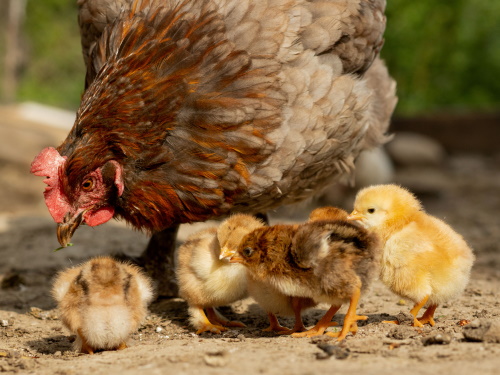
The chicken calls are “functionally referential,” as behaviorists are wont to say. In much the same way as our words, chicken sounds relay information on objects and situations in their world. Other nearby birds respond in kind, to acknowledge a need to flee a predator or approach a communal food source.
And their young are better in geometry than equivalent human babies. Giorgio Vallortigara of the University of Trento in Italy conducted a study proving that baby chicks have the ability to distinguish numbers and use geometry. Given a half-constructed triangle, chicks identified what the completed shape should look like.
Furthermore, animal behaviorists have shown that our fine, feathered friends pass down knowledge from one generation to the next and can remember up to 100 distinct faces, whether human or fowl. And as for sensitivity, hens who are carrying babies can communicate with them even before they hatch. The chickens cluck comforting messages to the chicks in their shells who chirp back audibly.
With nurturing skills like that, hens might offer humans a few parenting pointers.
PLEASE SHARE OUR BOOKSTORE — HELP US SELL MORE to DONATE MORE! 🙂
Frogs make mental maps
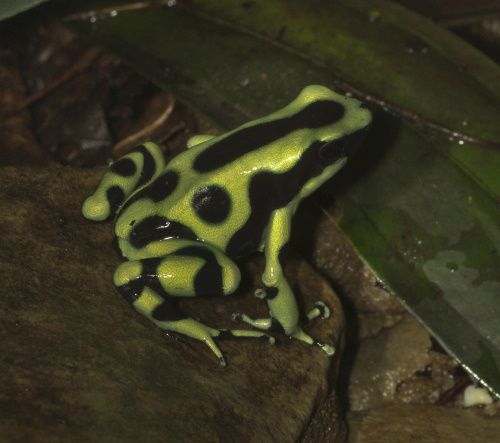
What if birthing and caring for your babies meant laying eggs on the forest floor, waiting for them to hatch, loading the infants onto your back, climbing up a tree, then placing them in bits of water you manage to find in holes, or in plants growing out of the tree? According to National Geographic, that’s what the tiny green-and-black poison dart frog (Dendrobates auratus) has to do.
To accomplish such complex feats of navigation and discernment, these frogs possess brains that not only can create mental maps of their surroundings, but are also able to revise them as conditions change.
One might argue that the females of this species are even smarter than the males. Apparently somewhere along the evolutionary way, they figured out how to get the guys to do a lot of the work. After the mom completes the egg laying, it’s the dad who minds the nest, then hoists up the tadpoles and chauffeurs them around to where they need to go.
Human papas, take note.
Cockroaches cooperate
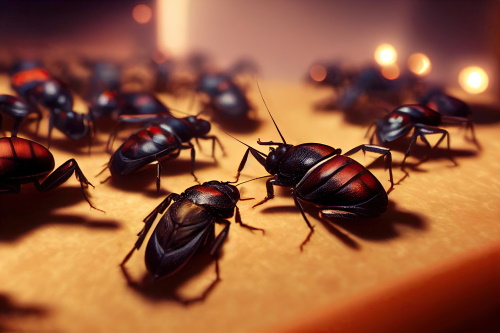
Come on now… cockroaches? Seriously? They can’t be too clever, can they? Well, researcher Mathieu Lihoreau suggests they exhibit “faculties of associative learning, memory and communication” comparable to those of honeybees, who are well-known for their sophisticated cognition.
In an article titled “The Social Biology of Domiciliary Cockroaches: Colony Structure, Kin Recognition and Collective Decisions” for the journal Insectes Sociaux (French for social insects), Lihoreau and coauthors James Costa and Colette Rivault reported that some roach species live together in communities, make group decisions on what to eat and where to hang out, seem to be able to distinguish each other as individuals, and apparently accomplish all this cooperation and democracy by communicating via chemical signals.
Sounds like they know how to get along better than we do.
The sensible roundworm
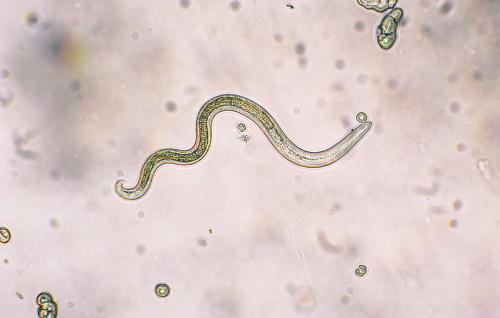
There is a wealth of data about the advanced characteristics of animals and insects that should make us stop and be more respectful of the natural world. You shouldn’t even sneer at the supposedly lowly roundworm (caenorhabditis elegans). It may be microscopic but it’s got one thing we could use.
Scientists at the Rockefeller University in New York found the roundworm has one of three neurons, labelled AIB, that can sense the smell of food, analyze it and then decide to either look for something else or not eat anything at that moment.
If only we had that neuron during the holidays.
Rescue Diva proudly helps needy animals in the U.S. and around the world, such as:
~ Diva donates to Center for Animal Protection and Education (CAPE), Praying for Paws, Southern California Siamese Rescue, Aniplant (Cuba) and many other groups.
~ Diva assists Kefalonia Animal Trust (KATs) in Greece to provide free spay/neuter for hundreds of animals per year, which is one of the best ways to prevent the abandonment and misery of puppies like Noah and Kyla.
~ Diva does in-the-trenches rescues of angels like Robin, Chance, and Tiger, with help from San Diego Animal Support Foundation; of Marisol and Lisa, with help from Last Chance at Life; of Mandi (Diamandi), with help from Graeske Hunde. and of Roki, with help from Stichting AAI.
DON’T MISS ANY DIVA! Hit FOLLOW button below.
About the author:
BRAD SCHREIBER has written for all media, and served as producer, executive, director, instructor and actor. Music Is Power (Rutgers University Press), a history of sociopolitical music, received a Foreword INDIES award. Brad’s true crime recounting of the Patty Hearst-SLA case, Revolution’s End (Skyhorse), was honored by both the International Book Awards and Independent Publisher Book Awards. Becoming Jimi Hendrix (Da Capo/Perseus), an early years biography, was called “fascinating” by the New York Times and selected for inclusion in the Rock and Roll Hall of Fame Library.
Before becoming a literary consultant via www.BradSchreiber.com, Brad was Vice President of Storytech Literary Consulting, founded by Christopher Vogler (The Writer’s Journey). Journalism includes Variety, HuffPost and Backstage, honored by the National Press Foundation, Edward Albee Foundation and L.A. Press Club.
Oct 28, 2022 @ 05:24:03
I think I entered my recsue page as Rescue by Alexis. I forgot the Cat. Should read: Cat Rescue by Alexis. Please help the rescue here. There is no program in place to help here. I am on the island of Evia in Greece.