

Surprising diagnosis for ill dog

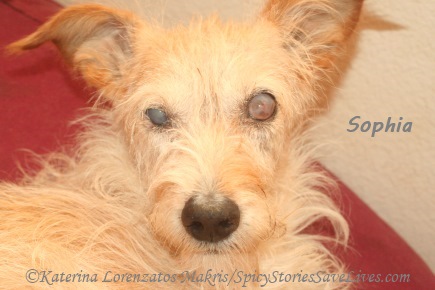
Before she went blind, Sophia was always the self-appointed defender of the meek in our bustling pack of rescues and fosters.
Now she needs hours of care daily for various symptoms
including her blind, inflamed eyes,
which itch and fill with mucus if not regularly cleaned.
by Katerina Lorenzatos Makris ~
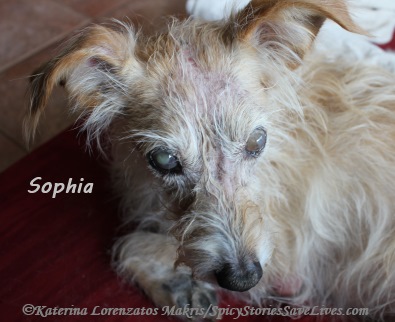
Her skin has gone haywire:
hair loss, white flaky patches and dark gummy patches.
Our senior dog Sophia is trapped in the grip of monsters. They are microscopic, but monstrous nonetheless. It’s hard to imagine more vicious or voracious foes.
To make matters worse, her enemies did a good job of disguising themselves. Until just a few weeks ago, we didn’t even know who they were.
This sweet girl suffered heinous abuse and neglect before we rescued her on the Greek island of Kefalonia back in 2003. Using her own resilience and grace, she transcended her nightmarish past.
To me she is more than just a survivor. She is a veteran warrior from the battlefield of cruelty, a courageous testament to the triumph of sheer endurance over evil, a hero. And now she faces the fight of her life.
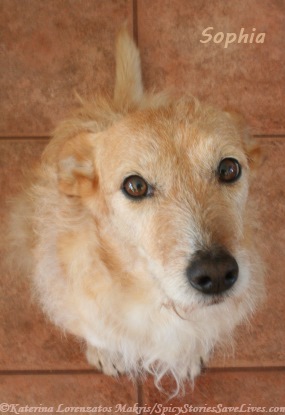
Sweet, strong Sophia in healthier days
December 30, 2010
Stealthy assailants are silently but surely ripping her little body apart. We are at her side, working hard to give her the weapons she needs to win her battle against them. But will that be enough?
Wide range of troubling symptoms
A decade ago, before I brought Sophia home with me from Kefalonia to California, I got her tested for two of the most common and dangerous parasites that afflict dogs in Mediterranean countries: Leishmaniasis, which is carried by a particular species of sand fly that is not found in the United States, and Ehrlichia, carried by ticks.
The reputable Athens laboratory that ran those tests showed her to be clear of Leishmaniasis, but positive for Ehrlichia. We gave her the standard 30-day course of the antibiotic doxycycline for her Ehrlichia.
During the subsequent several years she enjoyed remarkable health and vigor. While our other dogs would get the occasional diarrhea, vomiting, ear infections, hot spots, or other ordinary ailments, this petite Irish terrier mix rarely got anything.
She often surpassed much younger and larger dogs in speed, agility, and smarts. With a firm but fair paw, she took a diplomatic role in our sizable and ever-changing pack of rescues and fosters, staring down the bullies and standing up for the pushovers.
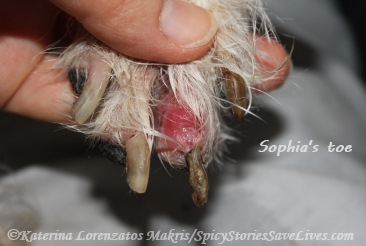
Some of her toes become inflamed and swollen.
Several nails are withered, yellow, and brittle.
Then in 2012, at age 11 or 13, she developed the following symptoms:
- Weight loss from 26 pounds down to 19 pounds
- Cataracts
- Corneal edema causing the eyeballs to swell and sometimes turn red
- Eyelid inflammation
- Blindness
- Chronic itchy spots and lesions on the inside flap of one ear, and on her hips and elbows
- Chronically poor teeth and gums
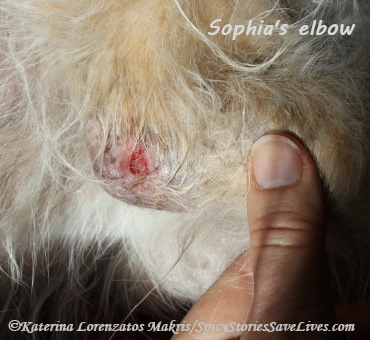
Chronic lesions on Sophia’s elbows, hips, and other spots.
Later she developed:
- Mild anemia
- Inflamed, swollen toes
- Withered, dry, brittle nails
- Dry, scaly skin on nose
- One incident of severe pain, perhaps in her back, that made her scream whenever she tried to stand
- Heart murmur
In general, Sophia’s veterinarians treated her symptoms as unrelated, and so did we. It did not occur to us to look for sole causes of such a wide range of ailments.
Sudden and rapid decline
For those ailments Sophia received, among other medications, three or more courses of the oral steroid prednisone during 2012 and 2013.
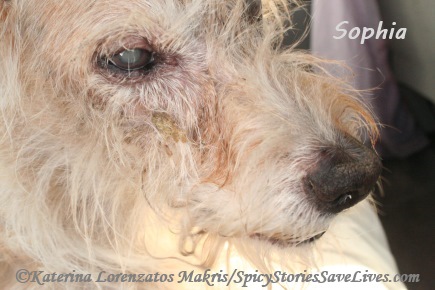
Inflamed eyelids, hair loss, and more skin troubles
After the last course of prednisone ended in September 2013, she developed two new symptoms:
- An unsightly skin condition—white flaky patches and dark gummy patches
- Hair loss
- Lethargy
In October, during a course of the antibiotic clindamycin prescribed to address a mild systemic infection in her blood—which seemed to be attributable to her bad teeth and gums—she started to lose interest in eating.
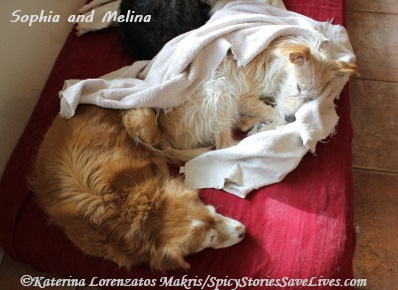
In September through November 2013, Sophia slept most of the day.
Her devoted friend Melina rarely left her side, watching over her.
My husband grew very worried. He kept using words like “frail” and “fragile” for her. It was hard for me to fit those words into my head. Sophia had always been our little Olympic athlete—one of the most robust creatures I had ever met.
Also I was distracted and worn out after doing a lot of rescue and fostering in the past two years. Exhausted much of the time and coping with a back injury, my mind was often on other dogs or elsewhere.
One night in October I dreamed that Sophia was evaporating—sort of disintegrating, disappearing, bit by bit. The next day, watching her lie on her bed as quiet as a corpse, no longer even thumping her tail when she heard me approach, I understood the truth.
Our beautiful girl was dying.
Stunning diagnosis
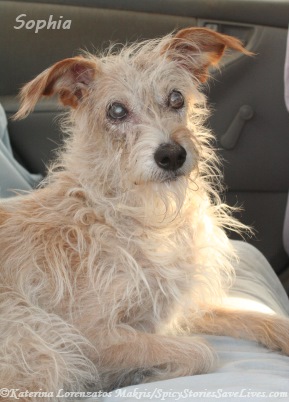
Because she loves car rides,
Sophia perked up a little during
the frequent trips to vets we made
in September through December.
Years ago when we first rescued her she was terrified of all things automotive but valiantly overcame her fears.
During the next couple of weeks I went on a something of a research rampage, determined to identify at least what was killing her, and to learn how to save her, if possible. Afraid I was doing too little, too late, I hauled her around on what amounted to more or less a tour of southern California’s veterinary specialists.
Most were baffled.
An ophthalmologist was the first one to utter a stunning word to me—the word that turned everything around.
“You need to get Sophia tested,” she said, “for Leishmaniasis.”
My jaw dropped.
“Leishmaniasis? ” I squawked. “But I already got her tested, back in 2003. She was negative for it. And that was ten years ago. Leishmaniasis is extremely rare in the U.S., so she couldn’t have picked it up here. Are you suggesting she has been harboring it for a decade, since her time in Greece? And that the test we did back then was wrong?”
The ophthalmologist shrugged. “I think you should get her tested again.”
I thought she was nuts.
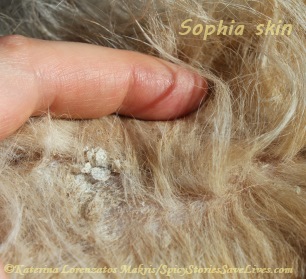
White flaky patches on her skin.
But the following week, I took Sophia to another specialist to whom the ophthalmologist had referred us—a man who many consider to be the top veterinary dermatologist in the United States.
After examining her he said, “I think we’re looking at a parasite here.”
I gulped. The ophthalmologist’s word echoed in my head. The word I didn’t want to hear. I thought there was no way the dermatologist could possibly say the same word.
“I think we’re looking at Leishmaniasis,” he said. “And maybe an additional parasite. Often when they have one of them, they’ll have another too.”
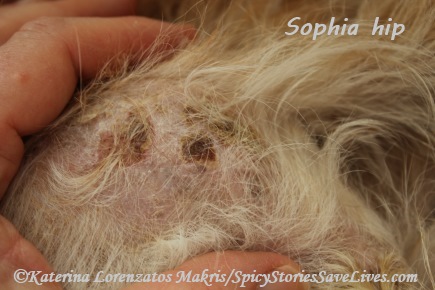
Lesions on her hips
Again, I argued with the doctor. I told him she had already been tested. That it had been ten years since she’d left Greece. That she couldn’t possibly have Leishmaniasis.
He shrugged. “She could have picked it up there after you had her tested.”
I shook my head adamantly. “No way. Every day during that month before she left Greece I used insect repellants to drench her and another one of the dogs we rescued that year. I had insect repellant collars on them too. How could anything have gotten through to them? Plus we were staying in a nice hotel in a ritzy Athens suburb. It’s not like we were living outside in the dirt.”
“I think we should re-test,” the dermatologist repeated.
Shock and denial
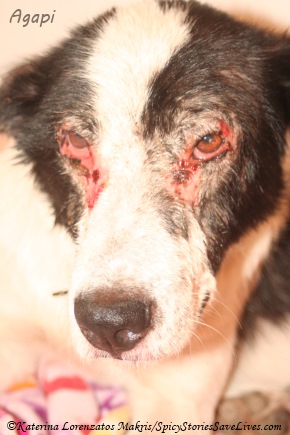
Agapi, rescued from the streets of Kefalonia mountain village Troianata in October 2012,
suffering from Leishmaniasis and Ehrlichia.
Still in disbelief—or maybe the correct word is denial—I drove home and called our vet in Greece, Dr. Amanda Micheletti. I described all of Sophia’s symptoms and sent photos. “Those two vets are crazy, right?”
There was a pause, then, “Why didn’t you call me sooner?” Dr. Amanda sighed heavily. “I could have told you right away. Those vets are absolutely right. Get her tested as quickly as possible. With the symptoms you’ve described I’m almost certain that Sophia has Leishmaniasis. And possibly another parasite too.”
My heart sank down to my knees. I felt dizzy. Last fall Dr. Amanda had saved my rescued boy Agapi from Leishmaniasis and Ehrlichia. It was a nightmare. When I first saw him wandering the streets of a Greek island village, he was a miserable mess of bleeding sores, stiff joints, twisted toenails, and malnutrition. The thought that our little Sophia might be yet another victim of that wicked parasite made me sick.
But Dr. Amanda deals with parasite cases every day; they are terribly common in Greece. She has copious experience in that department. Even if I didn’t believe anyone else, I had better believe her.
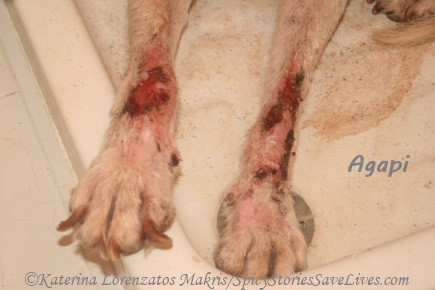
Lesions on Agapi’s paws and twisted, brittle nails ~
October 12, 2012, the day after his rescue
“Stop wasting time,” Dr. Amanda admonished. “Sophia is in grave danger. Go get her tested. Don’t waste another day.”
“I already have an appointment tomorrow with the dermatologist for the blood test,” I said. “I made it just in case. But I’m still so astonished by all this…”
“Get over it,” Dr. Amanda instructed, “because you have work to do.” Then, gently, she went on, “Look, you have a long and difficult road ahead. But if we act quickly, and if her liver and kidneys haven’t been affected yet, her chances for recovery are excellent.”
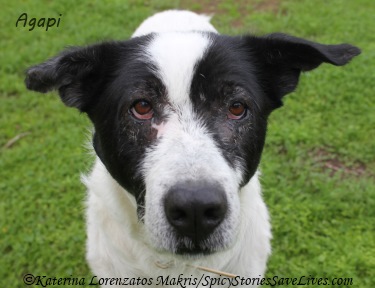
Handsome Agapi a year later
December 2013
“Really?” I choked back sobs.
“Look at Agapi,” she said. “Isn’t he happy and handsome now?”
I could hear the smile in her voice. She adores Agapi and had refused to let him die.
“But Agapi was only two or three when Leishmaniasis attacked him,” I pointed out. “Sophia is twelve or fourteen.”
“We’ve treated dogs just as old and in worse condition,” Dr. Amanda replied. “Then they lived on and died of something else years later. Sophia is a strong girl. You and your husband are strong too. Of course there are no guarantees, but I think chances are good that we can get her through this.”
Through grateful tears I murmured, “Thank you.”
“You just have to stay calm and focused,” Dr. Amanda reminded me.
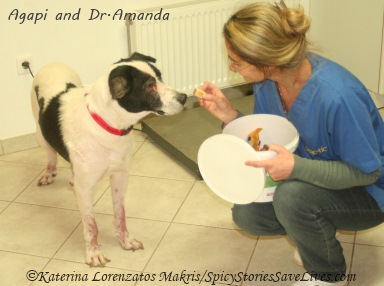
Dr. Amanda Micheletti of Kefalonia dispenses treats and TLC ~
December 2012
Calm and focused? I was in shock. The good news, I knew, is that with the right medications and care, Leishmaniasis is highly manageable. But I had seen up close and personal what it can do to dogs—not only to Agapi but to the many other street dogs suffering from it in Greece. It decimates them.
I took a deep breath, and realized that Dr. Amanda was right about at least two things: 1) Sophia is strong, and 2) she has two staunchly devoted allies at her side.
There was a third good thing: our international team of excellent vets. I knew that Dr. Amanda, along with the ophthalmologist, the dermatologist, and our regular vets here in San Diego would do everything in their power to help us defeat the monsters who were attacking our beloved friend.
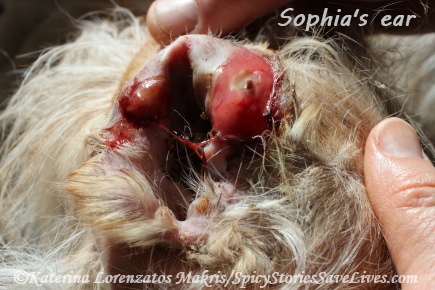
Gruesome lesion on the underside of her ear flap
There’s no denying the dark, destructive forces of parasites. But I realized we mustn’t underestimate our team’s forces of light and healing either.
Roll up the sleeves
Two weeks later the dermatologist phoned us with the results of the blood test. After we hung up I wept. The test had confirmed exactly what he, the ophthalmologist, and Dr. Amanda suspected. Sophia suffered from both Leishmaniasis and another insect-borne parasite, hemotropic mycoplasma.
Guilt slammed into me like a truck. How could I have been so stupid? Having seen plenty of parasite-afflicted dogs in Greece over the years, I should have recognized the symptoms. Foolishly I had let myself be blinded by the all-clear results of the 2003 blood test, and by the fact that Sophia had been away from Greece for a decade.
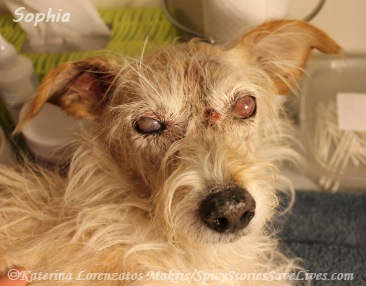
Caring for her is a lot of work, but with the right treatment this little fighter has good chances of feeling strong and peppy again.
And why hadn’t I acted faster when the ophthalmologist recommended that Sophia be tested again? With my head in the sand, I had wasted precious days.
After a long cry I dried my eyes. Stay calm. Focus.
OK. Not just one but two diabolical bugs had been conducting a clandestine, unopposed assault on our brave yet vulnerable girl for years. Dreadful news. But at least we had finally identified the enemy—a huge step in the right direction.
Now it was time to roll up our sleeves. Sophia has never been the type to go down without a fight, and neither have we.
The little devils destroying her were about to get a big surprise.
For more about Sophia and other animal adventures please FOLLOW Spicy Stories Save Lives by clicking the ‘SUBSCRIBE’ button above. You’ll receive email notifications of our new articles. We will NEVER give your email address to anyone else. And it’s free!
Spicy Stories Save Lives proudly sponsors needy animals in the U.S. and around the world.
For example we help Kefalonia Animal Trust (KATs) provide free spay/neuter for hundreds of animals per year, which is one of the best ways to prevent the abandonment and misery of puppies like Noah and Kyla. Please give to KATs via PayPal or bank transfer. Spay/neuter and education are the animals’ best hope for a better future.
Also please consider Animal Rescue Kefalonia (ARK), another group on the island who run a shelter and work miracles with terribly few resources.
Spicy Stories Save Lives and the author of this article have no affiliation with the rescue groups mentioned above, other than as a friend, volunteer, and donor.
 Seen our book? Your Adopted Dog: Everything You Need to Know About Rescuing and Caring for a Best Friend in Need, by Shelley Frost and Katerina Lorenzatos Makris, available through Amazon.com.

Jan 03, 2014 @ 00:11:50
Go Sophia! My force is with you, baby girl.
Jan 03, 2014 @ 03:18:33
I pray Sophie makes it. bless all of you fighting for her
Jan 04, 2014 @ 07:50:41
Thank you so much for your prayers and kind thoughts! We very much appreciate it.
Jan 03, 2014 @ 06:34:20
Awww poor little Sophia … Saying my prayers for her that she feels better soon . Lots of love . xxx
Jan 04, 2014 @ 07:52:10
Kirsty many thanks for the prayers and good wishes. Sending xxx back to you and the rest of the family including of course Mr. Benjamin Buttons!