

What does Rudolph do after the holidays? 18 awesome facts on reindeer habits and survival

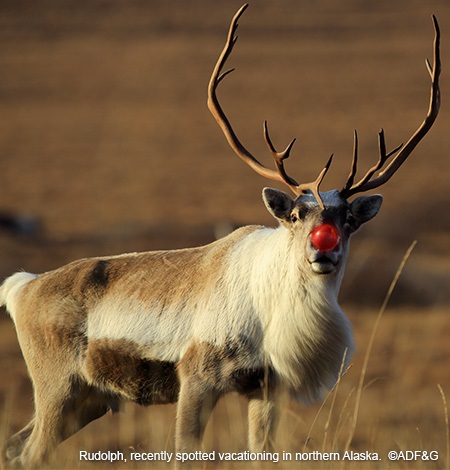
How does Rudolph spend the rest of the winter?
Photo: Alaska Dept. of Fish and Game
by Katerina Lorenzatos Makris ~

Might look unappetizing to us, but to reindeer, lichen is delish.
Now that Rudolph and the rest of Santa’s reindeer are enjoying well-deserved time off, let’s take a look at what they’re up to during the winter months, as well as at what the future might hold for them.
So what do they do all winter?
1. Eat lichen. Lichen? Well, to reindeer, it’s yummy. It better be, because there’s not a whole lot more on the menu at this time of year in their arctic and subarctic habitats. During their evolution the reindeer (a.k.a. rangifer tarandus or caribou) zeroed in on this mossy plant for the fuel they need to survive in icy climes. In warmer months they find more of a buffet such as the branches of certain trees and shrubs, mushrooms, and even dead animals. Once in a while they might catch a lemming or other small creature to munch. To get minerals they lick salty sweat and lap at sea water.
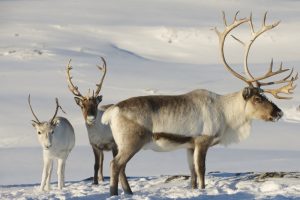
Reindeer are masters of survival in harsh conditions, but human impact on their habitat threatens their future.
2. Adjust their temperatures. Reindeer employ impressive strategies to cope with the cold. Their circulatory systems can lower the temps in their legs to a near-freezing degree so as to preserve heat in their cores. Their noses’ unique bone structure allows the nostrils to open up wide, heating the incoming air before it hits the lungs. They are consummate masters of survival under the harshest conditions of winter on the tundra and mountainous areas of northern Europe, Siberia, and North America. Nevertheless their numbers have drastically dwindled in recent decades, apparently due to climate change, which researchers believe has reduced their food sources as well as increased the populations of insects that plague them. Meanwhile other human activities such as mining, damming rivers, and building roads are encroaching on their habitats. For example the George River herd of eastern Canada once boasted nearly a million animals, but has dropped by more than 90% to only about 74,000 animals. The regional Cree and Innu people blame local industrial projects for the decline.
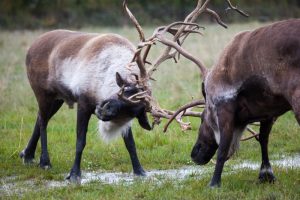
Female reindeer are the only deer species with antlers, which come in handy when they’re competing for food in the winter.
3. Grow antlers, if they’re girls, or shed their antlers, if they’re guys. Antlers help the females protect themselves and compete for food while they’re pregnant in the winter. The boys, on the other hand, have to go antler-less during the cold months, then grow them back in the spring. Apparently what’s good for the goose is good for the gander, since safe and successful pregnancies help with survival of the species as a whole. By the way, no other type of deer have antlered females. These ladies are uniquely well-armored. Watch out, fellas! But despite their formidable appearance and use as weapons, the antlers are actually flexible and warm to the touch, made of living tissue, with bone inside. Another strange but true bit of info: some people in Asia highly prize reindeer antler material, believing it is an aphrodisiac. Thus it is sold there for the purpose of enhancing human sexual desire and function. Go figure.
4. Grow beards and mustaches. To protect their muzzles from the snow, reindeer facial hair gets long enough to cover their lips. Move over, Duck Dynasty.
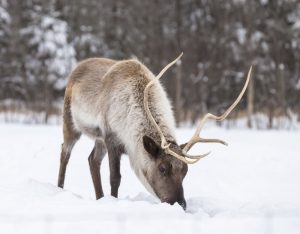
We can choose to get our meals from the freezer, but for reindeer in the winter, Mother Nature’s freezer is the only option.
5. Be furry. Dense layers of hair protect reindeer’s skin and body cores from temperatures that can plunge far below zero. The outer layer is made up of hollow hair, with up to 5,000 individual hairs per square inch. Underneath that, a fine and woolly layer boasts 1,300 hairs per square inch. Their coats are such effective insulators that when the animals lie down to rest, the snow beneath them does not melt, since no body heat is lost.
6. Be heavy. Adult reindeer range in weight from 150 to 550 pounds, depending on their subspecies. Wouldn’t you know it, though, that the males trim down for the Christmas holidays, while the females plump up? How are the ladies supposed to fit into those hot little New Year’s Eve dresses? Anyway, the guys have only about five percent body fat left after the busy autumn mating season, whereas the gals barrel into winter with a whopping 50% pudge index. But in reality the joke is on the guys. That glorious feminine fat—as thick as a couple of inches on their booties—serves as a fantastic natural insulator to protect Ms. Caribou and her pregnancy even when the thermometer dips down to 45 degrees Fahrenheit below zero.
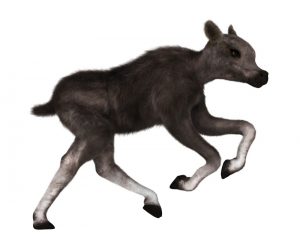
Baby reindeer can outrun you and me.
7. Run around. Of all the deer species these are the best endurance runners. It’s their only option for evading predators. Top speeds can get up to 50 miles per hour. Reindeer calves are up and running within a couple of hours of birth. Even a 20-pound newborn can outpace a human.
8. Swim. Those hollow outer hairs do a lot more than just insulate reindeer. They act as air pockets enabling them to stay afloat more easily when they take a dip, as well as help to keep the frigid water off their skin. Something must be working right, because reindeer have been clocked paddling at a brisk 6.2 miles per hour. Come on in, everyone, the water’s fine!
9. Sniff. Reindeer’s powerful schnozzes (including Rudolph’s red one, presumably) can detect lichen even when it’s buried under 60 centimeters of snow. This strong sense of smell also helps them sense danger, which makes up for their not-so-great eyesight. So don’t let those big beautiful brown peepers fool you. By the way, due to their inadequate eyesight, these animals have evolved other ways to keep their herds together during blizzards. For example when they walk, their tendons make a snapping sound that’s easy to follow.
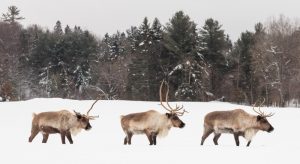
In their annual migrations reindeer travel farther than any other land mammal.
10. Dig. The name “caribou” is believed to come from a word meaning “one who paws,” in the language of the Mi’kmaq, a North American indigenous people. The moniker might have been inspired by the fact that these animals use their big hooves to paw through the snow and dirt to find food. The hooves are hollowed out underneath, so they can use them like shovels. To provide a good footing on ice or slippery rocks, the hooves have sharp edges. Due to their large size the hooves also serve as snowshoes to support these massive critters on drifts of the white stuff, and perform like swim fins in the water too.
11. Yell. Although they are fairly quiet in the winter, in autumn mating season the guys get pretty raucous. Under the skin of their throats they sport little inflatable pouches that make their bellows good and loud. Or at least they think they’re good. Kind of like guys watching football. All that yelling! The reindeer gals might think otherwise. (Ladies, you know what we mean.) Females have those air sacs too, which they use to individually tailor their communications with their young. In fact they tend to reserve all their vocalization for communicating with their young. Perhaps they do not wish to waste their warm breath on trying to converse with the fellas, especially during football season.
12. Trade tall travel tales. Reindeer stay put in the thick of winter, but at other times of year some subspecies carry out the longest-known terrestrial mammal migrations—up to 3,000 miles per year. They can hike about 23 miles a day.
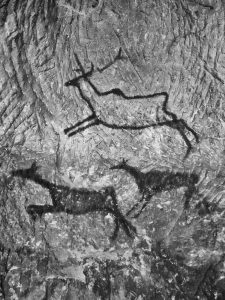
People have been drawing reindeer for at least 14,000 years.
13. Contemplate art. The British isles’ oldest known cave art, found in the Cathole Cave of Wales and dating from an Ice Age 14,000 years ago, depicts a reindeer with a spear in its neck. Not something you want to dwell on too much if you are a reindeer, but still it’s interesting to note that people thought about you often enough to sit down and do your portrait. Prehistoric art depicting reindeer has been found in several other places including the Cueva de las Monedas in Spain and the Grotte du Font de Gaume in France.
14. Be domestic. Reindeer are the only domesticated (or semi-domesticated) species of deer. In Europe and Asia few completely free-roaming herds survive. Some scientists believe the domestication thing started when climate change at the end of earth’s last glacial period caused the extinction of many other large mammals, forcing folks to focus more on reindeer as a food source. Today it’s more or less a nomadic practice, with certain groups of indigenous peoples closely following the herds’ natural migration routes, taming them to some degree, and practicing reindeer “husbandry,” which involves using them for things like milking and transportation, and ultimately killing the animals for meat, hides, antlers and whatnot. But these days it’s not always a matter of walking or skiing along with the critters on their long migrations—many herders use snowmobiles. Reindeer herders can be found in Norway, Finland, Sweden, Russia, Greenland, Alaska, Mongolia, China and Canada, and Scotland.
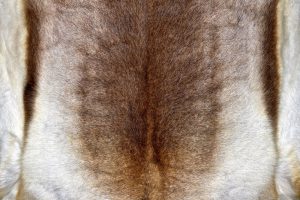
Since prehistoric times humans have used reindeer for their meat, bones, skins, antlers, and other parts of their bodies. Now the survival of this species is in question due to climate change, habitat loss, and other environmental threats.
15. Hope they don’t get killed by people. The language of the indigenous Sami people of northern Finland contains about 400 words for reindeer parts and the food, tools and other products made from their bodies. Yikes! That’s a lot of words. Humans have been hunting this animal for thousands of years. But nowadays there are some restrictions on the killing. In Finland and in other areas of Scandinavia only local residents and/or indigenous people are legally allowed to mess with Rudolph and his friends.
16. Hope they don’t get killed by animals. Gray wolves, arctic wolves, grizzly bears, brown bears, black bears, and wolverines are keen to make meals of reindeer. Lynx and golden eagles can carry off calves. The pragmatic mama reindeer of the tundra regions sync up their calving dates so as to give birth around the same time, overwhelming their enemies with their sheer abundance, and thus making sure that at least some decent number of their babies will survive to carry on the species.
17. Hope they don’t get killed by the weather and other natural hazards. Although reindeer are phenomenally resilient and built to survive really rough times, they face serious dangers. Severe winters that limit food sources can mean starvation. Rivers raging with high snow melt can drown even these great swimmers. Rudolph does not exactly have the life of Riley.
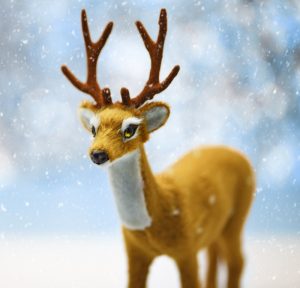
Rudolph and his friends are counting on you.
18. Hope you’ll help them. If the researchers are right, climate change and other problems caused by human activity pose the biggest threats to reindeer species’ future. The U.S. Fish and Wildlife Service includes the woodland caribou subspecies on its list of endangered animals. What can you do to help? Perhaps change your habits to reduce the amount of “greenhouse gases” that your lifestyle might be adding to the atmosphere and to the climate change problem? Maybe write to your lawmakers asking them to consider the impact that mining and construction projects might have on reindeer habitat?
Every little bit you can do adds up to help the world’s wildlife, including reindeer, who have served humanity for thousands of years, as everything from food sources to Christmas icons. Give it some thought. Rudolph and his buddies are counting on you.
Want to help animals while you enjoy a fun read? ALL PROFITS PLUS AN EXTRA $600 from sales of our romantic fiction story “Bow-Wows of Holly” through January 31, 2017 go to 6 great animal rescue groups!
BUY THE STORY! Only $2! Easy download using credit cards or PayPal.
OR take a look at our other stories–just $2 each! At least 50% of profits from sales of all RescueDiva.com fiction stories go to animal rescue groups! ?
Information for this article came from these sources:
Alaska Department of Fish and Game
United States Fish and Wildlife Service
Katerina Lorenzatos Makris is a career journalist, author, and editor. Her fiction includes 17 novels for Simon and Schuster, E.P. Dutton, Avon, and other major publishers (under the name Kathryn Makris), as well as a teleplay for CBS-TV, and a short story for The Bark magazine. She has written hundreds of articles for regional wire services and for outlets such as National Geographic Traveler, The San Francisco Chronicle, Travelers’ Tales, NBC’s Petside.com, RescueDiva.com, AnimalIssuesReporter.com, and Examiner.com (Animal Policy Examiner).
Together with coauthor Shelley Frost, Katerina wrote a step-by-step guide for hands-on, in-the-trenches dog rescue, Your Adopted Dog: Everything You Need to Know About Rescuing and Caring for a Best Friend in Need (The Lyons Press).
Jan 04, 2017 @ 23:42:04
Loved the article on the reindeers ! Delightful and Informative !!
Jan 05, 2017 @ 12:21:35
Thank so much for reading and commenting! Very glad you enjoyed the article! 🙂