

Saying ‘no’ to animal abuse: Greece’s heroic, gentle army of rescuers


HELP US SAVE ANIMALS — BUY A ROMANTIC STORY — JUST $2 !
by Katerina Lorenzatos Makris ~
Greeks are famous for saying “no,” and in rather cheeky ways.
In 480 B.C. Persian King Xerxes I, leading a well-equipped army of thousands, demanded that Spartan King Leonidas I and his relatively miniscule unit of only a few hundred surrender their weapons.
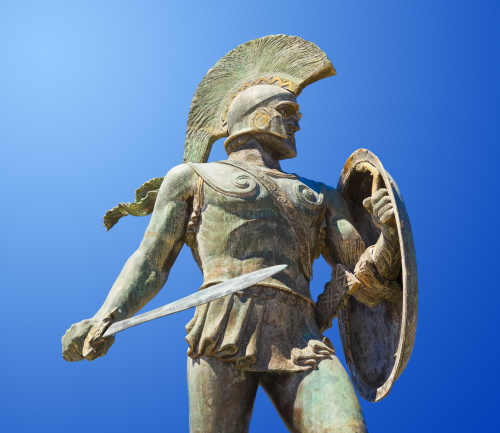
Leonidas responded, “Molon lave. Come and take them.”
During the ensuing Battle of Thermopylae, the Greek forces, who later became known as “The 300,” held off the advance of the mighty Persians for three days, literally fighting to the death to protect their homeland.
Technically it was an epic defeat. But the tale of their sacrifice became immortal. It lives on as an iconic symbol of courage and dedication—of struggling against overwhelming odds for a cause you know is right.
‘Oxi’ means ‘no’
Fast forward to October 28, 1940, near the start of World War II, when Italian Prime Minister Benito Mussolini demanded that that his troops be allowed to enter Greece. The response from Greek Prime Minister Ioannis Metaxas was simple: “Oxi.”

That word, meaning “no,” pulled the country into a brutal and unequal war against the Axis powers, causing immeasurable misery for years, including death by starvation of my own great-grandfather.
But historian Mark Mazower credited Greece’s fierce and clever fighting with the “first Axis setback of the entire war,” holding back the advance of Mussolini and Hitler for almost six months, “surprising everyone with the tenacity of their resistance,” setting an example, and giving the world a glimmer of hope against fascism and oppression of all kinds.
I feel deep gratitude to the courage of Greek soldiers like my adopted “uncle” Babis Lorentzatos, and civilians like my grandmother Stella Lorenzatos Makris, “aunt” Perla Kanali, “uncle” Yiannis Gnesoulis, “uncle” Fotis Lorentzatos, and uncle Cpt. Mimi Kouvielos, who all in their own ways did their part saying “oxi.”
This year, with the recent 81st anniversary of “Oxi Day,” I’ve also been thinking of the legions of another type of fighter—my fellow Greek animal rescuers, who every day, in the gentlest and most heroic ways, say “no” to callousness, to cruelty, and to the suffering of innocents.
BROWSE OUR BOOKSTORE FOR ROMANTIC TALES… ALL ABOUT ANIMAL RESCUE!
Sacrifices
Greece’s animal rescuers sacrifice their hearts, their souls, their brains, their bodies, their time, and their money. Some are of Greek background. Some are immigrants from the United Kingdom, the Netherlands, Denmark, Austria, Colombia, United States of America, and elsewhere. Others are just vacationers who, while enjoying the fabulous sights and experiences the country has to offer, come across needy animals they can’t leave behind. But all work hard to do what they can.
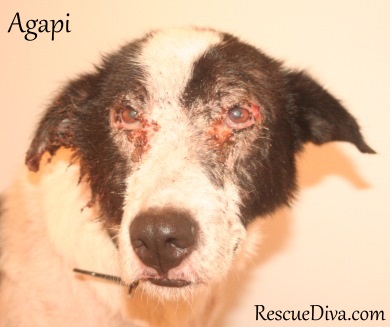
With nothing more than compassion, which is always the most powerful weapon, they combat the overwhelming forces of apathy and sadism.
Most rescuers are not wealthy. They have their own families for whom they must provide, and their own jobs where they must earn a living. They have their own needs and health issues.
But day after day they witness misery in the streets, on the beaches, in the fields, and in the mountains. Being who they are, they cannot turn away.
One by one they gather up the forgotten into their arms. They find places to keep them, which is not always easy, often being met with opposition from relatives, neighbors, or municipal governments. They squeeze their days to find the hours to care for their charges. They scramble for funds to pay for food and for veterinarians. They turn the world upside down searching for good and loving adopters.
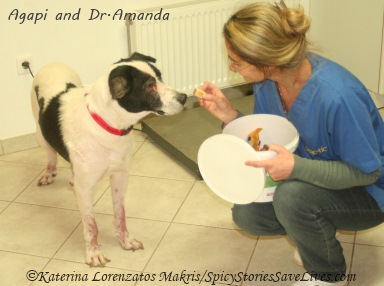
In spite of all challenges, they march forward. They have to. Because rescuers are who they are. They can know little peace if they leave an abandoned, hungry, ill, and/or injured animal to fend for itself.
Day after day on social media I see countless photos and stories posted by my fellow rescuers, not only of suffering animals, but also of their own suffering—their profound grief and frustration. Who with half a heart can see what the animals endure, and not share in the creatures’ pain and anguish?
If you live in Greece, this tragic parade takes a terrible toll on you. You see it and must deal with it day after day. There is no escape. No matter how much of your heart, soul, brain, health, time, and money you give to rescue the victims of your fellow humans’ inhumanity, there are still more and more animals in need, year after year after year.
PLEASE SHARE OUR BOOKSTORE — HELP US SELL MORE to DONATE MORE! 🙂
Age-old Greek traditions can guide and inspire rescuers
Greece is by no means the only country where inhumanity toward animals occurs. For example the U.S.A., where I currently live, is arguably the most wealthy and powerful empire in history, yet the problem of animal mistreatment in the U.S. is just as serious as in Greece and elsewhere. Here, too, there is a gentle army of rescuers who labor daily to save as many as we can.
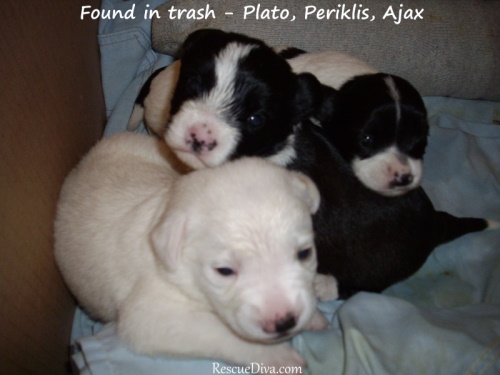
Failed animal stewardship is a global issue. Finding the right solutions to this complex and multi-faceted moral, social, economic, and political problem is extremely challenging, no matter how rich and resourceful a nation may be.
Greece is tiny—barely 11 million inhabitants—and not hugely rich or resourceful in the economic sense.
But Greece does possess magnificent riches of other kinds, such as the following deep roots:
1. An ancient tradition of compassion for animals: This goes back at least to the 5th century B.C.E., when brilliant philosopher and mathematician Pythagoras refused to eat animals’ flesh or to sacrifice them in his religious observances.
How to use it: We rescuers can find strength and solace in the knowledge that 2,500 years ago, the stellar minds of Pythagoras and others had already discovered the value of kindness to animals.
2. A famed philosophical emphasis on logic and order: The Stanford Encyclopedia of Philosophy declares that philosopher Aristotle’s thoughts on the nature and uses of logic have had “an unparalleled influence on the history of Western thought.” They also worked their way into Arabic and Latin medieval traditions. His and other Greek thinkers’ tenets of reason and order have left deep imprints on many facets of the modern world.

How to use it: We rescuers can draw on Greece’s long-standing values of logic, reasoning, and order as helpful tools while we work to make sense of the current chaotic and highly emotional situation of the animals’ predicament, and while we grapple with our own psychological trauma of witnessing so much misery.
3. A history of enormous contributions to the fields of science: It was Thales of Miletus, c. 600 B.C.E. who first “developed the idea that the world can be explained without resorting” to supernatural notions, and that it is “governed by the laws of nature,” as opposed to random mythical beliefs. WorldHistory.org calls the achievements of ancient Greek science “amongst the finest in antiquity.”
How to use it: As rescuers we can follow the timeworn Greek path of using science as a framework for finding solutions to the problem of animal mistreatment, rather than relying on outdated concepts that might no longer be appropriate, or perhaps never were.
4. The foundations of democracy: The governments of many countries today are modeled to some degree on ancient Greece’s system of self-government, as described by National Geographic Resource Library. Borrowed concepts include the rule of law, a written constitution, elections, states as separate but unified entities, lively dialogue and exchange of ideas, and of the rights of citizens who are dissatisfied with the decisions and actions of their leaders to protest and to work for change.

How to use it: To improve the lives of animals, we rescuers can band together, calling on age-old democratic principles to find and implement ways to change laws, government policies, and public attitudes.
5. Cultural resilience: Greece has endured countless invasions and other calamities, yet remained quite culturally stable. Some believe that’s owed to the strong Greek family structure. Others credit the Greek Orthodox faith. Still others cite the vitality that Greeks draw from their homeland’s magnificent seas, sparkling sunlight, and other natural wonders. Whatever the reason, Greeks are known for trudging forward–and even dancing–through the most challenging times.
How to use it: Greece’s world-renowned resilience can help lift rescuers out of the pit of frustration and hopelessness into which it’s so easy for us to fall.
Rescue Diva relies on sales of our fiction to create real-life happy endings like those of Claire, Tika, and Dolly. Enjoy a fun read while you replenish our rescue fund!
Rescuers can lead the way
Greek by heritage, I feel not only grounded, but also tugged by those historic roots of compassion, logic, science, democratic principles, and resilience.

Those roots can encourage all of us rescuers to honor our history and traditions. They can propel us to honor and celebrate each other, too, and to work in solidarity to sort out the ongoing disaster of irresponsible animal stewardship.
Rescue Diva can help
In another article coming soon we will propose a few ideas on how to move forward with those goals.
Also we will offer a new phase of our concrete assistance from Rescue Diva to rescuers in Greece.
And we will continue to spotlight the work of all animal rescuers, including those in Greece, as you’ll find here throughout our website, including on our Heroes page. [If you know a rescuer in Greece you’d like to nominate for our spotlight, contact us at the email address below.]
To implement these ideas and programs we all will need to continue using our unique, enormously powerful weapons—our soft hearts, our kind voices, our nurturing hands, and our questing minds.
Using those weapons is a far gentler way of saying “oxi” than how Leonidas and Metaxas had to do it, but it’s really just as cheeky.
May all who care about animals continue to walk forward together in the footsteps of those leaders, whose staunch replies to the inquiries of their oppressors were so simple, yet so definitive, so consequential, and so inspiring for generations to come.
RESCUE DIVA HEROES SPOTLIGHT: Know a rescuer in Greece you’d like to nominate? Contact us at rescuedivainfo AT yahoo DOT com. We spell it out that way to stop robot spammers, but you know the real way. 🙂
DON’T MISS ANY DIVA! Hit FOLLOW button below.
Rescue Diva proudly helps needy animals in the U.S. and around the world, such as:
~ Diva assists Kefalonia Animal Trust (KATs) in Greece to provide free spay/neuter for hundreds of animals per year, which is one of the best ways to prevent the abandonment and misery of puppies like Noah and Kyla.
~ Diva donates to Center for Animal Protection and Education (CAPE), Praying for Paws, Southern California Siamese Rescue, Aniplant (Cuba) and many other groups.
~ Diva does in-the-trenches rescues of angels like Robin, Chance, and Tiger, with help from San Diego Animal Support Foundation; of Marisol and Lisa, with help from Last Chance at Life; of Mandi (Diamandi), with help from Graeske Hunde, and of Dolly, with help from Stichting AAI.
Katerina has written hundreds of articles for regional wire services and for outlets such as National Geographic Traveler, The San Francisco Chronicle, Travelers’ Tales, NBC’s Petside.com, and Animal Issues Reporter.


Oct 30, 2022 @ 17:58:37
Thank you for sharing such an inspiring story. It’s great to see the spirit of Greek kindness in these rescuers!
Oct 31, 2022 @ 13:40:50
Thanks for your kind thoughts, and for visiting Rescue Diva!