

Ailing pets make life hard to plan

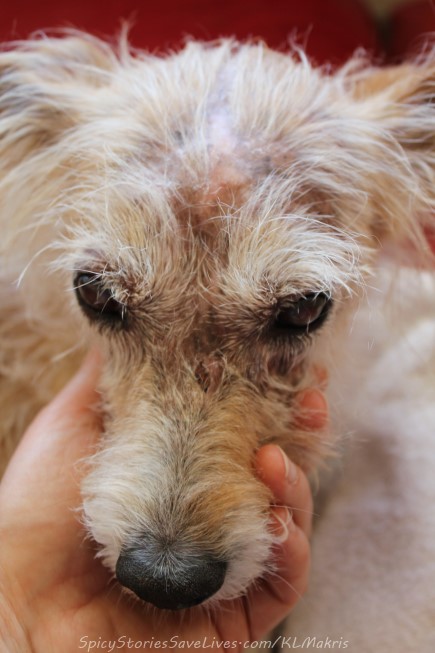
Watching Sophia’s Leishmaniasis-related eye inflammation and facial lesions improve has been delightful, till this week’s nasty little surprise…
by Katerina Lorenzatos Makris ~
Why can’t I get my act together, make plans, and follow through with much of anything these days?
It’s not like I’ve ever been the most organized drawer in the dresser, but now, with one and sometimes more of our big brood of rescued pooches ill, my metaphorical drawer tends to be even less tidy.
Exhibit A:
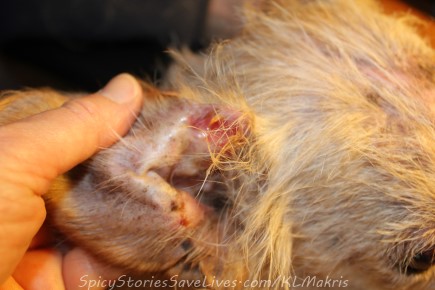
The gooey, bloody, crusty lesion that chronically plagued her ear for about two years suddenly returned.
Tuesday, while excitedly packing for the Farm Animal Rights Movement’s annual conference in Los Angeles, I discovered in horror that Sophia’s chronic Leishmaniasis-related ear lesion had erupted again.
Last winter Hubsy and I worked hard on that darn thing with twice daily cleaning, soaking, and dressing. It has been beautifully healed for months, then suddenly this week, just in time for the conference, KAPOW! It decides to make a comeback.
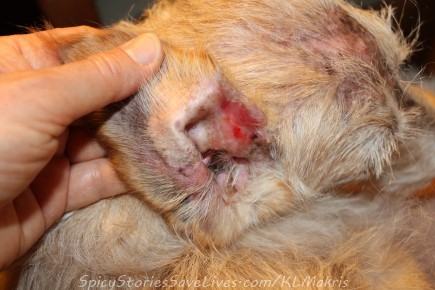
Success! It took a good hour, but finally got the hair trimmed off.
Spent an hour yesterday just trimming the fur around it. If we don’t, we get a gooey, bloody, hairy mess.
I thought the trim job would take only 10-15 minutes, but a certain little lady is not quite as docile as she was in the autumn and winter when the Leish parasite had sapped the strength out of her. Now that the Milteforan and Allopurinol medications are taking effect against the dreadful Leishmaniasis parasite, and now that she’s getting her feisty terrier groove back, she kept pulling her head away from me, trying to say, “Hey, that tickles!”
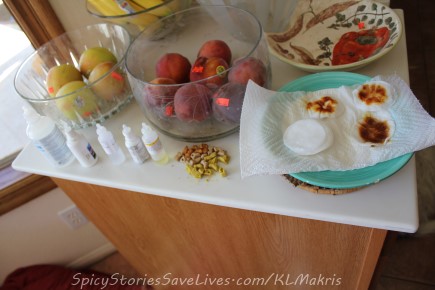
Among the Betadine-spritzed pads for cleaning her ear and the parade of meds for her eyes were plenty of bribes (cookies).
I was terrified that I might hurt her with the scissors if she made a sudden move. Lots of delicate skin and structures in there around the underside of her ear flap. Had to ply her with a constant stream of cookies to keep her cooperative.
Then the cleaning of that wicked wound was another long process. Needed to get it cleared of debris and disinfected, but with utmost gentleness so as not to irritate the skin further.
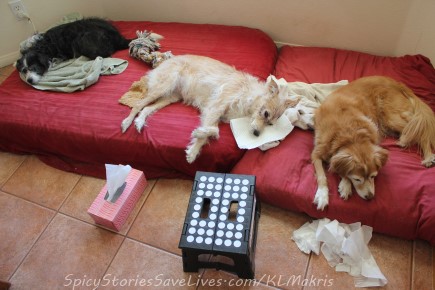
Usually I put her on our treatment table to clean and medicate her but this process was delicate so I sat on the stool and kept her on the bed with her pals Kalypso (left) and Melina (right) to keep her as mellow as possible.
The last thing we want is to give her any reason to paw at it, which is how we’ve ended up with a far worse wound in the past. Even though we keep a soft protective bonnet on her to prevent scratching, she can still sometimes get her little hind paw in there and wreak havoc.
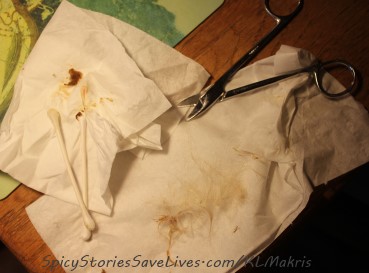
Scissors were necessary but scary.
By the time all was said and done with that, along with assorted other small-to-medium doggy crises the past few days, I had to miss the conference’s opening program this evening. The drive to L.A. from home in San Diego county took a couple of hours, including a 30-minute detour thanks to the fact that they closed the 405 freeway for middle-of-the-night repairs, so I didn’t arrive at the hotel till 2 a.m.
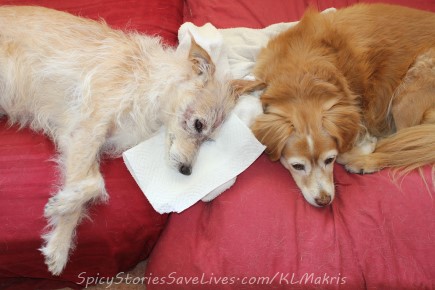
Back in 2003 when mild-mannered Melina (right) first joined our family, Sophia became her self-appointed bodyguard against the other dogs. While Sophia has been ill, Melina returns the favor by staying constantly at her side, providing moral support.
Now at least I’m here in time to catch a few hours of snooze then be ready to roll for the conference’s first full day beginning at 9 a.m., all thanks to dear Hubsy, a.k.a. The Saint, who once again valiantly stays home alone to do battle with that loathsome lesion and to hold down the rest of our little Fido Fort.
Related articles:
Don’t wait too late: dogs from Leishmaniasis-endemic countries must be tested and re-tested
Sympathy pains: Do you and your pet suffer from the same ailment?
Dog’s mystery illness: Can you guess what it is?
Surprising diagnosis for ill dog
A bloody dog standing in the road: What do you do?
Finding a severely ill street dog turns life upside down
Animal rescue styles: Ms. Savvy Sensible vs. Buckaroula Banzai
Vive la France! Reader’s email inspires animal issues writer to keep on typing
For more animal adventures please FOLLOW Spicy Stories Save Lives by clicking the ‘SUBSCRIBE’ button above. You’ll receive email notifications of our new articles. We will NEVER give your email address to anyone else. And it’s free!
Spicy Stories Save Lives proudly sponsors needy animals in the U.S. and around the world.
For example we help Kefalonia Animal Trust (KATs) provide free spay/neuter for hundreds of animals per year, which is one of the best ways to prevent the abandonment and misery of puppies like Noah and Kyla. Please give to KATs via PayPal or bank transfer. Spay/neuter and education are the animals’ best hope for a better future.
 Also please consider Animal Rescue Kefalonia (ARK), another group on the island who run a shelter and work miracles with terribly few resources.
Spicy Stories Save Lives and the author of this article have no affiliation with the rescue groups mentioned above, other than as a friend, volunteer, and donor.
Seen our book? Your Adopted Dog: Everything You Need to Know About Rescuing and Caring for a Best Friend in Need, by Shelley Frost and Katerina Lorenzatos Makris, available through Amazon.com.
Jul 11, 2014 @ 15:45:42
OMG! This is such a blow for you again – it makes me realize that my 5 “Spanish” dogs are equally at risk of developing this terrible illness (one has already developed the illness, as I mentioned to you before.) So I shall be re-testing them all.
The question I ask myself is: if the parasite is in the dog’s body, but at so-called “negative” levels (the case for all of them before they came to me here in France), they are not negative at all!!! It is there and waiting for that ideal opportunity to rear its ugly head.
Yet, none of the associations through which I adopted them, ever told me to get them re-tested…
Thank you, Katerina for being so brutally honest – you have helped to open my eyes!
Jul 17, 2014 @ 22:09:30
Jennifer sorry for the delayed reply. Thanks so much for the sympathy – you’re very sweet – and mine to you for your baby who has Leish. But under your loving care I bet he’ll be fine.
You’re doing the right thing by getting all your Spanish pooches tested. I’ll keep my paws crossed that you get 5 all-clears back from he lab!
Thanks also for your kind words about the articles, and for calling me “brutally honest”! Truly that’s the nicest thing you could say to a writer/reporter, because that’s our top job. And on a more personal level, Leish has put such a giant dent in life for Hubsy and me, on top of the misery it has caused our angel Sophia, that it’s important to me to spread this info so as to save others from this nightmare.
Regarding the rescue associations and groups who don’t let their adopters know that dogs from Leish-endemic countries must be re-tested after 6 months, I believe that in some cases it’s just innocent ignorance. In other cases, though, I am told that some groups don’t want to “scare off” adopters. You can imagine my feelings on that! So I’ll be doing an article on that topic soon.
As for your question about the “negative” levels, yes, the problem is that it can take up to 6 months after the dog contracted the parasite for it to show up in a blood test. So if they were infected less than 6 months before they were tested, the test might indeed show them “negative” for the parasite. Also, veterinarians have told me that it is not impossible for tests to be performed incorrectly and thus give incorrect results, though they feel that would be more rare.
Anyway, just as you said, the parasite can indeed be lurking in their bodies undetected by the test. And maybe the dog can fight it off for months or years. But if the dog’s immune system dips, or as the dog ages, the parasite can flourish.
That’s why a second test 6 months after the first one is imperative. If the parasite is in a dog, the more of a head start we can get on fighting it, the better.
Best of luck with all your fur babies! I’ll look forward to hearing good news!!