

Don’t wait too late: dogs from Leishmaniasis-endemic countries must be tested and re-tested


Our sweet Sophia in healthier days, 2010. Unbeknownst to us, the Leishmaniasis parasite lodged inside her, waiting for a chance to flourish. A strong and resilient girl in both body and spirit, she fended it off, exhibiting no symptoms for almost a decade. Then, last autumn, all heck broke loose.
by Katerina Lorenzatos Makris ~
“This dog does not have Leishmaniasis,” a fellow rescuer insisted.
I was urging him to get a pooch he had found in Greece tested for that deadly parasite.
“No way,” he said. “I’ve been rescuing here for 12 years. Don’t you think by now I’d know the symptoms?” Then he laughed.
I couldn’t bring myself to join in the laughter.
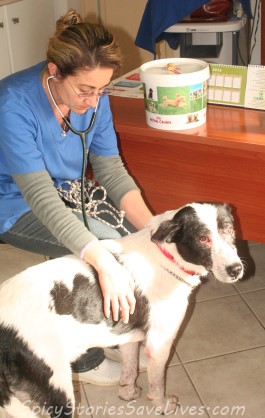
Caring and brilliant vet Dr. Amanda Micheletti with Agapi, who she saved from a nasty case of Leishmaniasis
I used to think that way too. I thought Leish would make itself obvious. And every time one of my rescued dogs’ initial blood tests came out clear of the parasite, I would relax and toast our good luck.
Sadder but wiser now, I’ve learned the hard way that Leishmaniasis is no joke, and that celebrating after only one test might be premature. This powerful parasite can be amazingly sneaky.
Spread by the bite of a certain insect species—the phlebotomine sand fly—in countries where that insect exists, the microscopic Leishmaniasis invader typically causes obvious and onerous ailments in dogs within months after they are bitten.
But some dogs’ immune systems are strong enough to fight it off for years. There are even dogs who can carry the parasite in their blood their whole lives, never showing any symptoms, then die at ripe old ages of something completely different. But more often, if this nasty bug is left to its own dastardly devices, it makes dogs horribly ill at some point along the way.
Test early and often
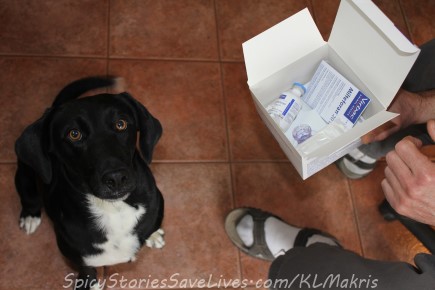
Beautiful Julia in our kitchen in California, about to receive her first dose of Milteforan. Before coming to us, her home was at Animal Rescue Kefalonia (ARK) which struggles valiantly to care for hundreds of animals on a shoestring budget, but does not have enough funds for testing and treatment of all the dogs. Donations made to the group are put to excellent use for needy sweeties like Julia.
To that merrily confident friend, and to all my fellow Greekie pooch rescuers and adopters, I gotta say it: please don’t be blithe like I was. For your dogs’ sakes and for your own, follow these steps:
1. Get your dogs tested for Leishmaniasis as soon as possible.
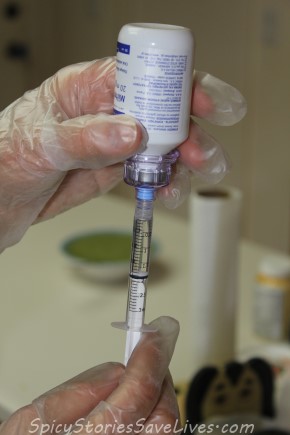
A 28-day treatment with Milteforan (a.k.a. Miltefosone), is highly effective for Leishmaniasis. Relatively easy to give at home, this liquid medication is measured into a syringe, then mixed into the dog’s food. Leish-positive dogs must also receive Allopurinol, an inexpensive drug in pill form, every day for life.
2. Don’t rely on the SNAP test that can be done quickly in the veterinarian’s office—ask your vet to send the blood sample off to a reputable lab for a titer test.
3. Get your dogs re-tested. Do not rely on just the first test.
If you’ve gotten the dogs from Greece (or from any other place where Leish is endemic such as Spain, Italy, and several other countries), and even if the dogs were already tested while still in Greece, you must test a second time six months after the date they leave Greece. Please note that the re-test must not be done before six months have passed, because it can take that long for the parasite population in the body to develop enough to be detected by the test.
Then consider testing again once per year for seven years.
4. If you live in Greece (or another Leish-endemic area), definitely test once per year.
Leishmaniasis is easy to treat when caught early
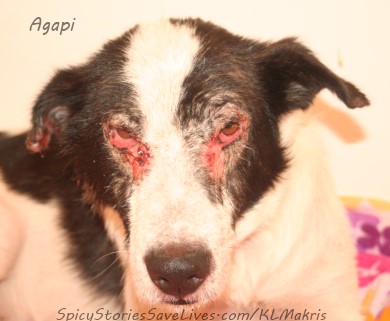
Street dog Agapi suffered from a raging case of Leish, exhausted and thin, with sparse, coarse fur and bloody lesions all over his legs, ears, and face.
The wonderful news is that when it’s caught and treated early, Leish is usually no big deal.
My husband and I have a total of three Leish-positive dogs here with us now in California.
Julia, a lovely young pointer mix from the Animal Rescue Kefalonia (ARK) shelter in Greece, had no symptoms but tested positive last July. We gave her the 28-day course of the recommended medication called Milteforan (also known as Miltefosone), plus we are giving her the easy and inexpensive Allopurinol pills (called Zylapour in Greece), which all Leish-positive dogs need daily for life. Thank goodness she is doing fine.

Agapi just a few weeks after treatment. His lesions started to heal. He felt stronger, peppier, and posed like a show dog!
Agapi, on the other hand, had plenty of symptoms. His skin got badly walloped by the parasite. A two-year-old Greek mountain shepherd dog, he suffered from grotesque, bloody lesions and from exhaustion when I found him on the streets of Troianata village on the island of Kefalonia in September 2012. But we gave him the meds too, and luckily he has made a fabulous recovery.
Unfortunately our third case, Sophia, a 13-year-old terrier mix, didn’t get the meds till the parasite had hidden in her body for more than a decade. Thus she faces a tougher battle, and provides an excellent example of the critical importance of early treatment.
Sneaky Leishmaniasis
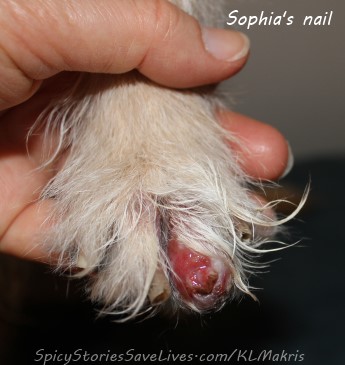
Leishmaniasis attacked some of Sophia’s nails, turning them brittle and crooked, and making the nail beds raw and bloody.
Life has been in a tailspin for my husband and me since last fall when we discovered that Sophia suffers from Leish. Before her diagnosis, we and several veterinarians were baffled as to what was causing her many symptoms. We did not know that this parasite occasionally eludes even the topnotch Athens lab blood titer test, or that it might take six months after the first test to develop to the point where it shows itself.
Nor did we know that a dog might show zero symptoms for seven or more years—yes I do mean seven years—then KABAM!
That’s what happened with our sweet Sophia. We rescued her from Kefalonia way back in 2003 and got her immediately tested for Leish through the Athens lab before we brought her to live with us in California. That test result was negative, indicating she did not have the parasite. So we believed she was in the clear.
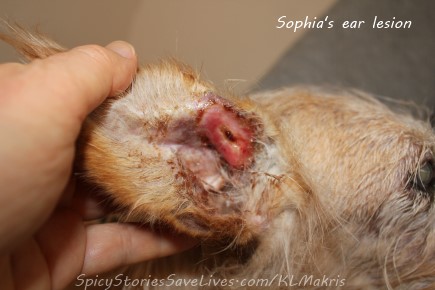
A severe and stubborn lesion on the underside of Sophia’s ear flap was a living nightmare for her and for us, requiring gentle yet thorough cleaning and dressing several times per day for almost a month until it healed.
She exhibited no symptoms for about seven years. Then this dastardly parasite went to work. First it blinded her. Then it created raw, itchy lesions on her skin, mangled her nails, weakened her teeth, dulled her appetite, reduced her weight, and caused several other problems.
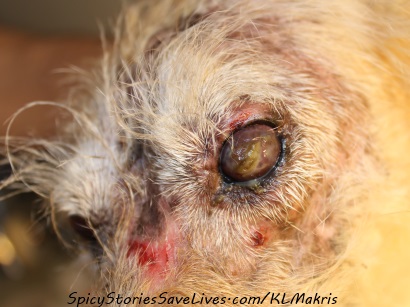
Leishmaniasis permanently blinded Sophia. Now, after treatment, the parasite is much tamer but continues to plague her eyes with inflammation and thick mucus. It rips up her beautiful face with bloody sores and lesions. This all requires hours of daily care, and would have been easily avoided if only we had gotten her re-tested and treated sooner.
Most vets in the U.S. and northern Europe have never seen or studied Leish. There’s not much reason for them to do so since it’s extremely rare outside of the endemic countries.
To those who don’t recognize the disease, the symptoms often pose a mystery, and a typical course of action is to treat the dogs with prednisone to reduce inflammation. But ironically that’s almost the worst drug that can be given, even at low doses, because it weakens the animal’s immunity and allows this parasite to flourish.
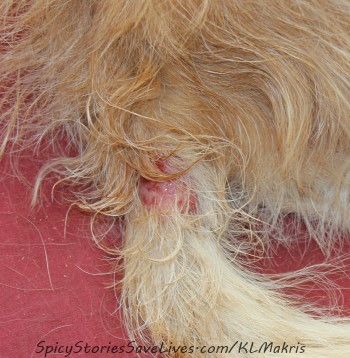
Another stubborn lesion erupted at the base of Sophia’s tail.
That’s exactly what happened in Sophia’s case. Not knowing yet that her symptoms were due to Leish, we treated them with three courses of oral prednisone within about a year. The third time, last August, seems to have been the “charm” from the parasites’ point of view. She plummeted downhill very fast with a variety of symptoms. We had no idea as to the cause. We never would have dreamed it was Leishmaniasis.
In the absence of a diagnosis or a cure, we seriously considered euthanizing her.
Grim game against a sinister opponent
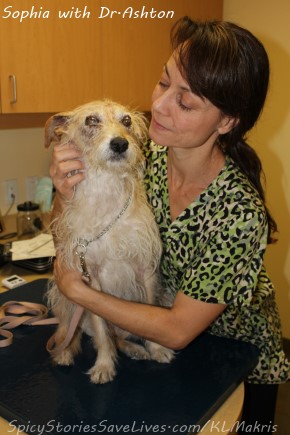
Caring and brilliant veterinary ophthalmologist Dr. Marcella Ashton with Sophia. Though Leish is rarely seen in the U.S., Dr. Ashton recognized the symptoms and urged us to visit another fabulous vet, Dr. Craig Griffin, for testing and treatment. The diagnostic talents of our vets came just in time to save Sophia’s life.
Desperate for answers, I took Sophia to several specialists. Then, on a gut feeling, I tried Dr. Marcella Ashton, a veterinary ophthalmologist at California Veterinary Specialists. I thought maybe since this vet is from another country, South Africa, she could offer a different perspective. Much to my shock, I was right, but not in any way I’d expected.
After a few minutes of examining Sophia, Dr. Ashton urged me to get her tested for Leish.
I argued with her. Sophia couldn’t possibly have come down with it after all this time away from Greece. Anyway, the test we’d done in 2003 had come out negative for the parasite. It just couldn’t be Leishmaniasis.
But Dr. Ashton gently insisted we see Dr. Craig Griffin of Animal Dermatology Specialists, recognized as one of the top animal dermatologists in the U.S, if not the world. True to his stellar reputation, he too correctly spotted Leish symptoms. He and his resident vet Dr. Kasie Stetina sent Sophia’s blood to a specialty lab in North Carolina for confirmation.
The news came in November: Leish was indeed the name of the grim game.
Ongoing battle
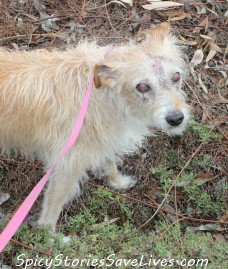
Sophia is amazingly better now, enjoying her meals, twice-daily walks, beloved car rides, and other fun.
With excellent and patient guidance from Leish expert Dr. Amanda Micheletti back on our home island Kefalonia in Greece (I was phoning her almost daily and she never
charged me a cent) we completed the Milteforan medication in January, and Sophia improved quickly and dramatically.
But in late April our girl’s skin and eyes suddenly went haywire again. Though she’s doing hugely better now, we’re not out of the woods yet.
Overall, we’re lucky. The Milteforan and Allopurinol have made tremendous improvements in her quality of life. Those meds have allowed Sophia to once again enjoy her twice-daily walks, eat well, regain most of the weight she’d lost, and reclaim her longtime throne as firm yet benevolent queen of our bustling pooch family.
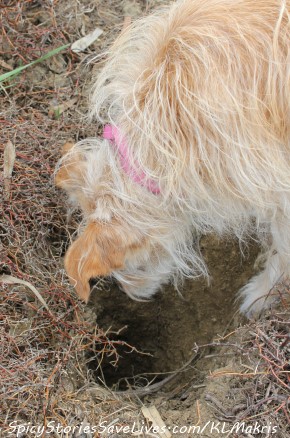
Sophia, after treatment, investigating a bunny tunnel. Last fall, before treatment, her waning strength allowed no such interests.
We are also supremely lucky to have caring, supportive, and clever vets helping us through. Dr. Micheletti, Dr. Ashton, Dr. Griffin, Dr. Stetina, the doctors at Melrose Animal Hospital and their many super staff members have gone above and beyond all calls of duty for Sophia’s challenging case.
But if not for the blindness that Leish caused, and if not for the discomfort of the eye and skin troubles, our Sophia would be still be racing around the yard and digging for gophers the way she used to. She’s a tough little cookie so I know that being age 13 would not have stopped her. It took a sinister foe like Leish to slow her down.
Lots of time, money, and heartache
I am spending two to three hours a day just keeping Sophia’s inflamed eyes and skin lesions clean and medicated. For both her sake and mine, I wish I didn’t have to. This is having a serious impact on my work and on my life.
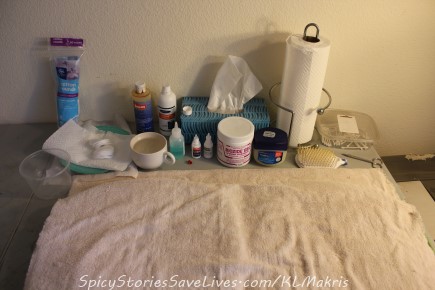
Sophia’s treatment table, where I spend hours per day cleaning eyes and lesions and applying medications.
My husband, a.k.a. The Saint, is also spending at least an hour per day caring for her, plus has taken over some of my other doggy duties so that I can focus on our neediest one.
Not to mention the more than $3,000 so far in veterinary costs. All the vets have kept the fees down for us but it can’t all come for free.
The emotional toll on us, too, is pretty hefty. It’s not easy watching one of our beloved best friends get ravaged from the inside out, as Sophia has been, by tiny but voracious monsters.
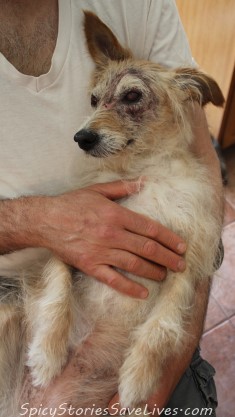
Sophia in the The Saint’s arms
I wish we had known to get her re-tested. I wish we could have spared her the suffering this villainous parasite causes.
I wish we could have spared ourselves from it too. We will gladly and lovingly provide all the care she needs until we see she is no longer enjoying life. But I wish we could have skipped this harrowing chapter of her life altogether—wish we could have kept her healthy—which we could have done, had we only known to get her re-tested.
Testing is simple and relatively cheap
You can skip this chapter in your own dogs’ lives. If they come from Leish-endemic countries, or are living in one now, you can easily spare them and yourselves this whole nightmare with simple, relatively inexpensive testing and early treatment.
Pardon my soapbox, but I wish someone had told me, so I felt I’d better tell you, because Leishmaniasis is really no laughing matter.
Related articles:
Sympathy pains: Do you and your pet suffer from the same ailment?
Dog’s mystery illness: Can you guess what it is?
Surprising diagnosis for ill dog
A bloody dog standing in the road: What do you do?
Finding a severely ill street dog turns life upside down
Animal rescue styles: Ms. Savvy Sensible vs. Buckaroula Banzai
Vive la France! Reader’s email inspires animal issues writer to keep on typing
For more animal adventures please FOLLOW Spicy Stories Save Lives by clicking the ‘SUBSCRIBE’ button above. You’ll receive email notifications of our new articles. We will NEVER give your email address to anyone else. And it’s free!
Spicy Stories Save Lives proudly sponsors needy animals in the U.S. and around the world.
For example we help Kefalonia Animal Trust (KATs) provide free spay/neuter for hundreds of animals per year, which is one of the best ways to prevent the abandonment and misery of puppies like Noah and Kyla. Please give to KATs via PayPal or bank transfer. Spay/neuter and education are the animals’ best hope for a better future.
 Also please consider Animal Rescue Kefalonia (ARK), another group on the island who run a shelter and work miracles with terribly few resources.
Spicy Stories Save Lives and the author of this article have no affiliation with the rescue groups mentioned above, other than as a friend, volunteer, and donor.
Seen our book? Your Adopted Dog: Everything You Need to Know About Rescuing and Caring for a Best Friend in Need, by Shelley Frost and Katerina Lorenzatos Makris, available through Amazon.com.


Jul 09, 2014 @ 06:34:06
As usual…. Graphic story told as experienced. I have posted this on the ARK site as I feel everyone should be made aware of this dreadful killer.
Jul 09, 2014 @ 08:49:14
Thanks so much for reading, for your kind comment, and for sharing the link!
Oct 09, 2014 @ 05:18:03
Thank you for the great article. We have just found out that our pug rescued from Malta 3 months ago has tested positive with a reading of 1/800. He has not yet shown any symptoms but obviously we want to prevent it ever getting to that stage. Would you suggest getting him on Allopurinol straight away? We are based in Germany and have a good vet who seems quite knowledgeable.
Also, do you know of any way of finding out when the disease was contracted? He is 5 years old and we presume he lived in Malta all his life before coming here so he could even have been carrying it all this time?
What would you say are the earliest signs to look out for?
Oct 29, 2014 @ 07:59:19
Andrew, apologies for this delayed reply! We have been redesigning the Spicy website and it has been quite a challenge for computer ninny me. Anyway, thanks so much for reading the article, and for your kind comments.
Thanks also for rescuing a sweetie from Malta! Sounds like an adventure. Am so glad you got him tested right away. Chances are you’ve saved him and yourself a lot of grief.
Please note that I am not a veterinarian, so of course you must double-check everything with a vet, however, just from my own experiences, here’s the best of my knowledge from what vets have told me regarding my own rescues, and from the experiences of others with whom I’ve spoken…
First, you are correct to want to begin treatment, even though he has no symptoms. The absence of symptoms means almost nothing. Dogs can appear just fine for years while the horrible parasite is quietly doing its dirty work, then suddenly become terribly and irrevocably ill. Our sweet Sophia had it for at least SEVEN YEARS before she showed any symptoms, then it blinded her and caused other wicked symptoms very quickly.
YES I would start your lovey on Allopurinol immediately, under a knowledgeable vet’s guidance. (It’s generally quite safe but you must have an experienced vet’s guidance for doses and for managing occasional side effects such as urinary crystals.)
Also your pooch should probably start on another med called Milteforan (Miltefosone) ASAP. But PLEASE NOTE this would be only if he were deemed well enough to tolerate it. If the dogs’ liver, kidneys, etc. are still in good shape then they usually tolerate it quite well with few side effect other than perhaps some temporary nausea or diarrhea. Must get blood tests and an exam to make sure all is well before beginning the Milteforan.
Milteforan is not cheap – for a pug’s weight I imagine it will be somewhere in the 100E-150E range, but it is a miracle drug, if you ask me. Apparently it is the current most effective medication, widely used, and saving lots of dogs. We witnessed rapid and dramatic improvements with our own dogs.
As far as I know it is not really possible to determine when the disease was contracted. I suppose vets might be willing to guess based on the titer level since that shows the amount of the parasite in the body. But even that would be inconclusive, I would think, because I’m told each dog’s immune system deals with the parasite differently – some are stronger and can control the parasite better than others.
WOULD YOU PLEASE EMAIL ME at spicystories AT yahoo DOT com so that we can communicate further about this? I have a few more ideas for you and would love to chat.
THANKS AGAIN for reading Spicy and for rescuing and caring for your little fellow!!
~ Katerina Lorenzatos Makris
Dec 27, 2014 @ 07:45:18
Really good site.
I got a question. We are thinking of getting a dog from the doghome in Spain (that;s where we live) The dog got a reading of 1/800 of leish. Does that means that she need injectons or are tablets enough. The tablets what I give to my other are Zyloric 300 mg. with Alopurinol.
Jan 22, 2015 @ 16:36:25
Hi Hilde! First of all thanks so much reading Spicy, and many many thanks for wanting to adopt! That’s wonderful! 🙂
I am not a vet, so I can’t advise you on medications, etc. However I can tell you about the treatment that was recommended to us by our vets, and which they say they have found to be successful with many other dogs.
I’m not sure what the reading of 1/800 indicates because again, I’m not a vet. Anyway, I think the values might vary from lab to lab.
However, what I’ve understood from our vets is that if a dog tests positive, even in a low titer level, he must have 2 things:
1. Milteforan (Miltefosone) every day, once a day, for 28 consecutive days, in the dose prescribed by your vet, mixed in thoroughly with food.
2. Allopurinol every day for LIFE, in the dose prescribed by your vet.
Then you must test again 6 months after the last day of the Milteforan treatment, to see how it worked.
In Spain there are probably many great vets with a lot of experience with Leish, and I’m sure they will be able to give you proper advice.
Please let us know how things turn out?
Thanks again for visiting Spicy, and wishing you and your pooches all best!!
Jan 22, 2015 @ 21:14:56
Everybody thanks for all your support. The vet had good news for me. My dog Sally is in the lower division of Leish. She has to take 1 tablet a day. She is absolute a great dog. I’m glad that We picked her up from the dogrescue home.
Jan 07, 2015 @ 14:45:50
That is terrifying. My husband and I have been discussing getting a second dog and we thought a rescue from Spain/Portugal etc. would be the decent thing to do. Lots of shelters say they test for it but none have mentioned that it can lay dormant for years. We live in Switzerland and so far I haven’t been very impressed with the level of care our other two pets have received when they’ve been sick. It’s a scary thought that we could adopt an infected dog and then not be able to find them the appropriate care if they got sick. Could they still get really sick even if they’re being tested every 6 months?
Jan 07, 2015 @ 14:46:23
Also, thank you for your post!
Jan 22, 2015 @ 16:23:01
You’re very welcome and many thanks for reading, Heather!
Jan 22, 2015 @ 16:22:21
Hi Heather ~ Thanks so much for reading Spicy, and please forgive this delayed reply!! First off, thanks for wanting to adopt! Yes it is indeed the decent thing to do. 🙂 I just wrote you a really long reply, so I think I’ll send it to you via email rather than post it in this comments area. Then, because the reply might be of interest to others, in a few days I’ll post it as an article here on Spicy. Thanks again!
Jan 11, 2015 @ 16:06:09
Katerina,
In your story you mention that giving Prednisone to a known leish-infected dog is bad. Do you have any veterinary references to “prove” this? I have a leish dog from Italy here in the USA who has annual relapses. I treat with Miltefosine and Allopurinol, but sometimes this can take a week or two to fully take affect. He has severe anemia (PCV=20,17,14 over the past 4 days, even though all other symptoms are improving) and my American vets are loading him up with Prednisone to fight the anemia. I am afraid this will do more harm than good, but I find conflicting information online.
Thanks!
Kevin J.
Jan 21, 2015 @ 20:09:52
Kevin so sorry for the delayed reply!!! (Ironically I missed seeing your comment earlier because we were dealing with the illness and death of one of our sponsored puppies, probably caused by yet another dastardly protozoan, Neospora caninum.) In response your question… First, thank you so much for reading Spicy and for loving and caring for a Leish-positive pooch! What a lucky fellow he was to find you!!! I am most definitely not a vet and have zero veterinary training. However vets with a lot of experience in fighting Leish and other parasites both in the U.S. and in Greece have warned me in no uncertain terms that because oral prednisone lowers immunity, it’s terribly risky to give it to Leish-positive dogs. In my own experience, our dog Sophia’s sudden decline with Leish (before we knew she had it) was almost certainly triggered by an injection of prednisone, according to her vets. Anecdotally, I have been told of at least 3 similar cases – dogs whose immune systems were managing to fight off the parasite till they were given prednisone, which suppressed their immunity and allowed the Leish to flourish. Again, I am not a vet, but I think in your shoes I would ask my vets to look into this question further. Because Leish is so very rare in the U.S., our vets here don’t have much if any experience with it, so sometimes they might need to research it a little more so as to have all the necessary info. Hmm… actually… now you’ve made me curious… I’m going to ask my vets if they know of any published studies on the question of prednisone, so that if you like you can refer your vets to those documents. I’ll send you an email too. Meanwhile thanks again so much for visiting Spicy and for all you’re doing for your Italian sweetie!
Mar 08, 2015 @ 14:13:18
I’m very sorry your dear dog Sophia got this horrible disease. Unfortunately I’m going through a very similar situation. We took our 12 years old dog to several specialists before getting the answer of what was actually happening to her. Now we are on day 14 of milteforan, but we haven’t noticed any clinical improvement yet. We are very concerned about it. How long did it take your Sophia to get any better? Thank you.
Mar 20, 2015 @ 09:52:48
Mariana, please forgive this long-delayed reply. Many thanks for reading Spicy, and for your kind sympathies about Sophia – deeply appreciated.
Nearly two weeks have passed since you left your comment, so by now you must be nearly finished with the 28-day course of Milteforan, right? Have you seen any improvement yet? I hope so! Could you give me an update when you have time?
In general, what I’m told by the vets is that the combined therapy of Milteforan and Allopurinol can bring rapid and significant improvement. It’s not unusual to start seeing changes within 2-4 weeks. However it might take longer. From what I’m told the Milteforan stays in the body and keeps working to kill the parasites for many months after the 28-day course is done. That was certainly the case for us.
With Sophia we were about 3 weeks into the Milteforan course when we noticed she wasn’t developing new skin lesions, and the ones she had were starting to heal. She continued to get better, and in the weeks then months after we finished the Milteforan, the improvements in her skin and elsewhere became dramatic.
The hideous inflammation and bulging of her eyes receded, and she got generally more comfortable, energetic, and interested. Things weren’t perfect: she still had some lesions that required cleaning and care, she remained blind so she needed help getting around and protection from our boisterous other dogs, and she needed several small walks throughout the day instead of a long one, because her stamina wasn’t great. But she was overall pretty peppy and happy.
My husband, the vets, and I feel that the combined therapy of Milteforan and Allopurinal bought her 8 months of good quality life. In fall 2014 we had been about to euthanize her because even after visiting several specialists we didn’t know what was wrong with her thus had no way to cure her horrible ailments. Thank heavens I decided to go to one more specialist, Dr. Rebecca Ashton, a veterinary ophthalmologist and extremely clever detective in California, who diagnosed the Leishmaniasis, bless her. Armed with the correct diagnosis, we were then able to get loads of help from Dr. Amanda Micheletti in Kefalonia, Greece, who graciously accepted my phone calls and millions of questions several times a week. Both of those vets as well as dermatologist Dr. Craig Griffin and those at Melrose Animal Hospital and all their wonderful assistants and staff members gave us kind TLC and thorough guidance on care and treatment throughout the following 8 months. We feel very lucky.
In Sept. 2014 Sophia took a sudden turn for the worse, and we euthanized her three days later, but I am forever grateful to all those vets and their crews for giving us those 8 great last months with our sweet girl.
Because Leish and other parasitic illnesses are so sneaky and unpredictable – sometimes manifesting in ways and at times you wouldn’t expect – I believe it’s crucial to have vets who are willing to think and to search for answers and solutions “outside the box” for diagnosis as well as for treatment and care.
Apologies again for taking so long to reply. I pray that your baby is better now, and look forward to hearing from you when you have a chance. If you have any more questions please let me know. Of course I’m not a vet but I’m super interested in this topic, so if it might help you, I’m glad to research by asking the vets I know. And I’ll be more prompt about replying next time!
Thanks again, Mariana, for reading and for contacting me. 🙂
~ Katerina Lorenzatos Makris
Sep 08, 2017 @ 09:21:57
Hi! I just came across this since our Galgo, Carlos, was diagnosed with Leishmaniasis last night. He started taking allopurinol, but I don’t know how to find the milteforan. Any suggestions? We live in California as well! We have plenty of ways to get it from Spain, but obviously want to start treatment ASAP. We were also recommended to give him renagel, which seems like a human med for kidneys, so that might be easier to access.
Oct 08, 2017 @ 11:07:46
Hello Kellie ~ Thanks so much for contacting us, and many apologies for this delayed reply. Hope it’s OK if I email you. Meanwhile congratulations on adopting a Galgo, and i’m so sorry to hear that he’s got Leish. But the good news is that it can usually be controlled so that he can have a long healthy life. Obviously i’m not a vet but i can let you know about our own experiences with Leish and what the vets have told us. Will try to email you now. 🙂